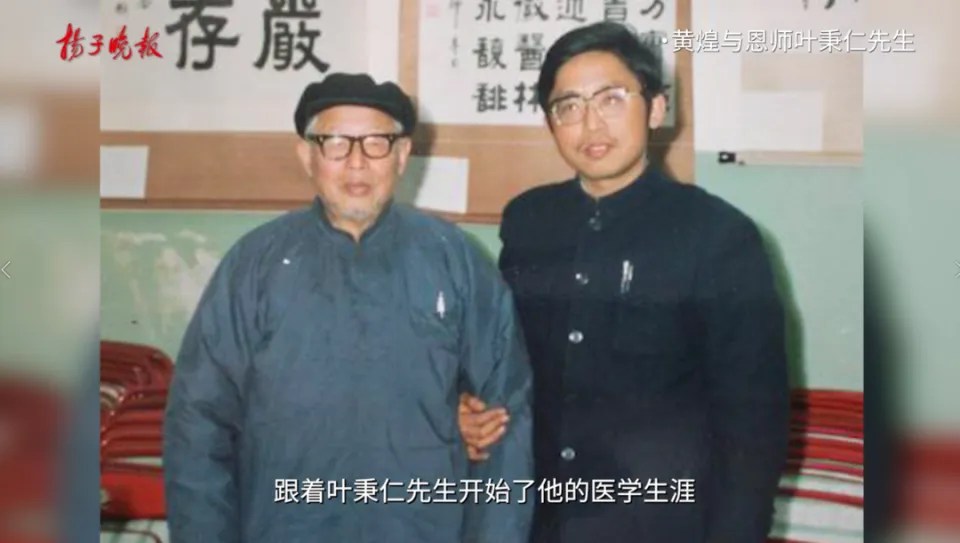
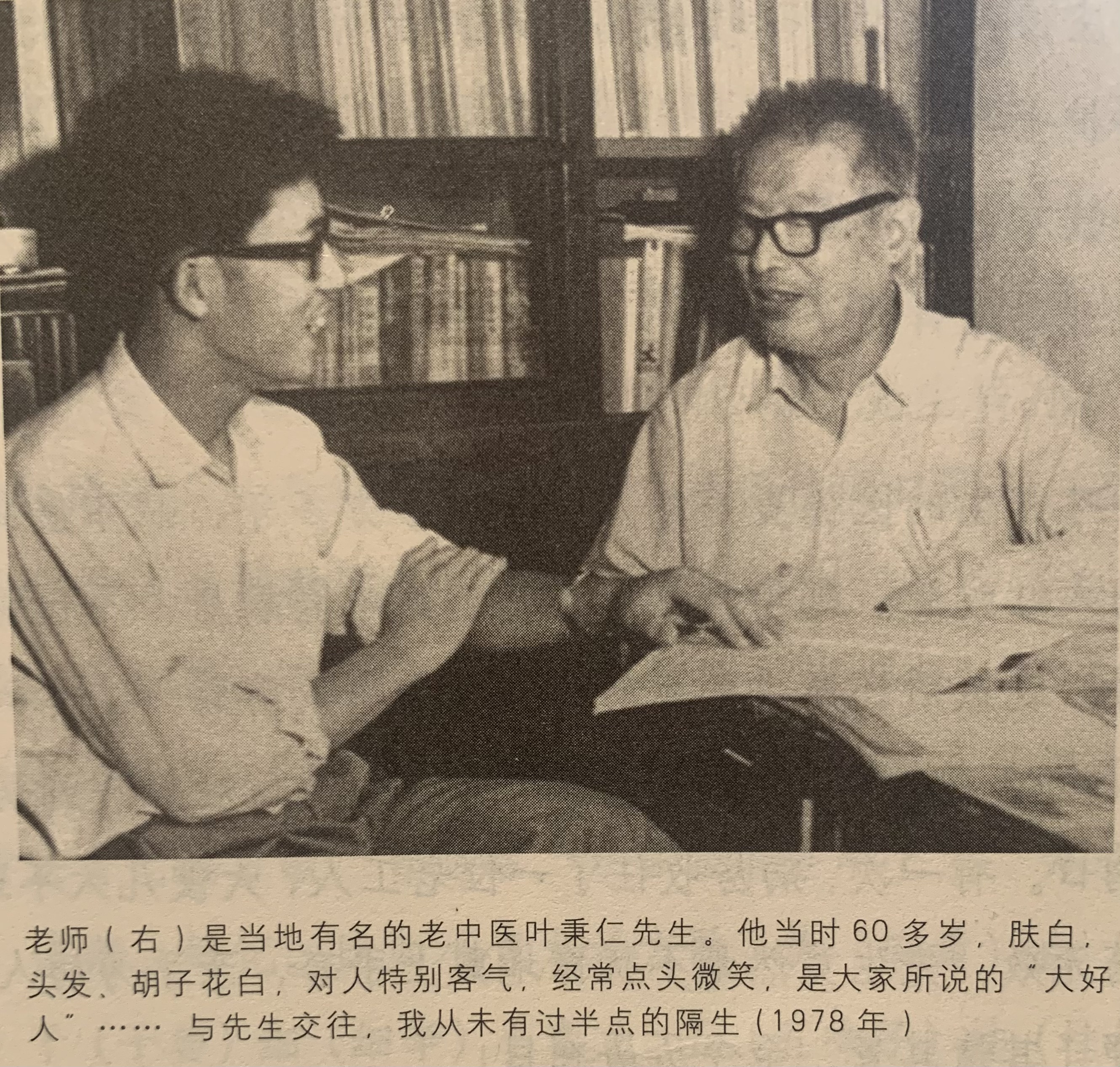
Ye Bingren (1908–1994), originally named Ye Bingcheng, was a native of Huashi, Jiangyin, Jiangsu Province, and was recognized as one of Jiangsu’s first distinguished Chinese medicine practitioners.
Ye devoted his life to clinical exploration in integrated Chinese and Western medicine and was recognized as a pioneer of this approach in Jiangyin’s Chinese medicine community. Ye Bingren was my teacher Professor Huang Huang’s first mentor in his own medical studies, and from 1973 onward, Professor Huang followed him at the Jiangyin Traditional Chinese Medicine Hospital, studying both Chinese and Western internal medicine for over six years.
Ye excelled in integrating Chinese and Western medicine, particularly in treating severe and critical conditions, and had extensive clinical experience in this field. He did not rigidly adhere to any single school or doctrine, skillfully utilizing classical formulas (jingfang), contemporary prescriptions, folk remedies, and herbal medicine. However, in Huang Huang’s view, his application of classical formulas was particularly distinctive. Practicing medicine for nearly 60 years, he saved countless lives using both Chinese and Western medical methods. He was one of the few senior Chinese medicine practitioners capable of handling emergency cases, outpatient consultations, and inpatient care.
The book Ye Bingren’s Medical Theories and Case Studies compiles and organizes his clinical experience, providing valuable insights for practitioners.
Case #1: A Malaria Case (Ye Bingren)
In the autumn of 1941, in Gongjia Alley, Huashi, Gong, who had recently married, suddenly developed chills followed by high fever and severe headaches, as if his head were splitting. After sweating, the fever subsided slightly, but the attacks recurred multiple times a day. On the fourth day, he fell into a coma. His relatives and father-in-law, who were knowledgeable in medicine, consulted renowned local physicians, all of whom diagnosed the condition as summer-heat disease, but their treatments yielded no improvement.
One evening, as the sun was setting, I was invited to examine him. I arrived to find his family gathered in panic. The patient was unconscious, but his pupils showed no abnormalities. His tongue was pale, indicating deficiency of qi and blood. His abdomen was full but not tender upon pressure, and a palpable mass was evident beneath his left ribs. Having treated similar cases successfully before, I determined that the condition was not beyond cure. The previous physicians had mistakenly attributed the illness to the six climatic factors, failing to recognize it as malarial toxin.
I prescribed a modified combination of Xiao Chai Hu Tang and Da Yuan Yin, adding Shi Chang Pu and Yu Jin. After four doses, the fever reduced, and his consciousness gradually returned. Upon the next consultation, his tongue coating was thick and turbid, and he passed foul gas, indicating a Shaoyang-Yangming combination disorder. I then prescribed Da Chai Hu Tang to purge the intestines and clear heat. After completing the prescription, his bowels moved, the fever subsided, and he recovered.
(Ye Bingren’s Medical Theories and Cases)
Commentary:
The term “pattern” (zheng) in pattern-based formulas refers to the clinical evidence used to select a formula. Disease names are crucial diagnostic evidence. The key to success in this case was the clear diagnosis of malaria, leading to the effective use of Xiao Chai Hu Tang combined with Da Yuan Yin. Classical texts describe Xiao Chai Hu Tang as treating “alternating chills and fever” that “stop and start periodically,” which aligns with malaria’s cyclic chills, fever, and sweating. The symptom “fullness in the chest and rib-sides“ also corresponds to splenomegaly and hepatomegaly seen in malaria. Later generations of physicians frequently used Xiao Chai Hu Tang for malaria.
As for Da Yuan Yin, it originates from the Wen Yi Lun (Treatise on Epidemic Diseases) and is essentially a modified version of Huang Qin Tang, serving as a fundamental formula for febrile diseases. The combination of these two formulas effectively clears heat and expels pathogens, leading to the patient’s rapid recovery.
***********************************************************************
Case #2: Persistent Dysentery Due to Yang Deficiency with Lingering Toxins (By Ye Bingren)
Patient: Hu, male, 6 years old.
Year: 1942, late summer to early autumn.
The child had been suffering from dysentery for several months, with little improvement despite various treatments. By the time he sought my care, he was severely emaciated, his eyes lacked vitality, and he was passing bloody and mucus-filled stools with abdominal pain. Additionally, rectal prolapse was observed.
Upon examination, his hands and feet were cold, his pulse was deep and thin, and his tongue was pale red with a glossy, peeled coating at the front and mixed yellow-white coating at the root. This indicated a condition of yang deficiency with lingering toxins, involving both deficiency and excess.
Treatment:
The approach required both warming and clearing therapies, so I prescribed a modified version of Baitouweng Tang from the Bei Ji Qian Jin Yao Fang, removing Houpo and Longgu.
Prescription:
- Baitouweng 10g
- Qinpi 10g
- Huangbai 6g
- Huanglian 3g
- Ganjiang 2g
- Danggui 10g
- Zhigancao 3g
- A small amount of Japonica Rice
- Ejiao 10g
- Chishizhi 20g
- Danfu Pian 6g
- Fuling 12g
- Hongzao 4 pieces
Outcome:
After three doses, the child’s body temperature normalized, pulse became stronger, and rectal prolapse resolved. Another three doses stopped the dysentery completely, and his appetite greatly improved. With further dietary adjustments, he made a full recovery. (From Ye Bingren’s Medical Theory and Cases.)
Commentary:
This case involves a complex pattern of pathogenic heat entering the jueyin and shaoyin conformations, causing dysentery with cold extremities and yang deficiency.
- Heat toxin damaging the lower burner’s blood level → bloody mucus stools
- Jueyin qi rebellion → abdominal pain
- Shaoyin cold transformation → fatigue, cold limbs, deep thin pulse
Because the condition involved both heat and cold, excess and deficiency, neither pure warming nor pure clearing methods would have been effective. Instead, a balanced formula combining warming, clearing, tonifying, and astringing herbs was used.
Therefore, I prescribed Bai Tou Weng Tang from the Bei Ji Qian Jin Yao Fang as it was quite suitable. This formula is derived from the Shang Han Lun’s Bai Tou Weng Tang, Si Ni Tang, and Huai Hua Tang, combined with Zhu Che Wan from the Bei Ji Qian Jin Yao Fang, and modified with Hou Po and Sheng Long Gu. The purpose of this combination is to use Bai Tou Weng to clear and expel the heat toxin from the intestines, Si Ni Tang to restore yang and rescue from reversal, Dang Gui and E Jiao to nourish yin and blood, and Huai Hua Tang to astringe and consolidate. By using both warming and clearing herbs together, addressing both deficiency and excess, the treatment achieves rapid results. This method reflects the effective practices learned from the experiences of later practitioners.
 Eran Even, Ph.D., Dr. TCM.