The following is a translation from Péng Zǐyì’s [彭子益] incredible ‘Circular Movements in Ancient Chinese Medicine 圆运动的古中医学
二十四节气圆运动简明图说
欲学中医须先认识十二经名词的所以然。欲认识名词,须先认识阴阳五行六气的所以然。欲认识阴阳五行六气,须先认识二十四节气地面上所受太阳射到的热降沉浮的圆运动。右下左上中,降沉升浮中,秋冬春夏中,西北东南中。图的虚线为地面,虚线下为地面下,虚线上为地面上。
To learn Chinese medicine, one must first understand the terminology of the twelve channels. To understand these terms, one must first grasp the principles behind yin and yang, the five phases, and the six qi [atmospheric influences]. To understand these, one must first become familiar with the circular movement of the heat that reaches the earth’s surface from the sun during the twenty-four solar terms. This movement encompasses the directions of right, bottom, left, top, and center; descending, sinking, ascending, and floating; autumn, winter, spring, and summer; and northwest, southeast, and other compass points. In the diagram [shown below], the dashed line represents the earth’s surface; below it is below ground, and above it is above ground.
图的圆线上方在云层之际,图的中心,为一个生物的环境的大气圆运动的中心。由中心以观察四维,便见一个生物所在地的宇宙范围,图的中心的中字,便是一个读者。降者,夏时太阳射到地面的热,降入土中也。沉者,降入土中的热沉入土下之水中也。升者沉入水中的热升出土上也。浮者,升出土上的热又与夏时太阳射到地面的热,同浮于地面之上也。中者,降沉升浮之中位也。
The upper part of the circle in the diagram represents the clouds, while the center represents the center of the circular atmospheric movement of a living environment. By observing from this center, one can see the universal scope of a living being’s habitat. The “center” character in the diagram signifies the reader. “Descending” refers to the heat that the sun emits to the ground during summer, which sinks into the earth. “Sinking” means this heat descends into the water beneath the earth. “Ascending” refers to the heat rising from below the earth to above the surface. “Floating” refers to this heat, which rises above the ground and coexists with the summer sun’s heat. “Center” represents the middle position among descending, sinking, ascending, and floating.
立秋为降之起点,立冬为沉之起点,立春为升之起点,立夏为浮之起点。秋分前,土上热多,土下热少。秋分则土上与土下的热平分也。春分前,土下热多,土上热少。春分则土上土下的热平分也。冬至者,由立秋降入土下的热,多至极也。夏至者,由立春升出地上的热,多至极也。降极则升,升极则降,升降不已,则生中力。亦大气圆运动自然之事也。
The point of descent begins at the start of autumn, the point of sinking begins at the start of winter, the point of ascent begins at the start of spring, and the point of floating begins at the start of summer. Before the autumn equinox, there is more heat above the ground than below. At the autumn equinox, the heat is balanced between above and below the ground. Before the spring equinox, there is more heat below the ground than above. At the spring equinox, the heat is again balanced between above and below. The winter solstice marks the peak of heat that has descended beneath the earth from the start of autumn. The summer solstice marks the peak of heat that has risen above the ground from the start of spring. When descending reaches its peak, ascending begins, and vice versa. This continuous rise and fall generate life force and are natural phenomena of the atmospheric circular movement.
植物经秋而叶落,植物个体的热下降也。经冬而添根,植物个体的热下沉也。经春而生发,植物个体的热上升也。经夏而茂长,植物个体的热上浮也。热的降沉升浮于植物个体求之最易明了。说植物个体的热的降、沉、升、浮,即是说宇宙大气的热的降沉升浮,即是说人身的热的降沉升浮。图的虚线,在宇宙为地面之际,在人身为胸下脐上之间。在脐上二寸。热性本来升浮,不能沉降,热之沉降,秋气收敛之力降沉之也。热降,为生物有生之始;热不降,为生物致死之因。详下各篇。秋气收敛详下文。
In plants, leaves fall in autumn, indicating the descent of heat within the plant. Roots grow in winter, indicating the sinking of heat within the plant. Budding in spring shows the rising of heat, while thriving growth in summer shows the floating of heat. Observing the descending, sinking, ascending, and floating of heat in plants makes this concept easy to understand.
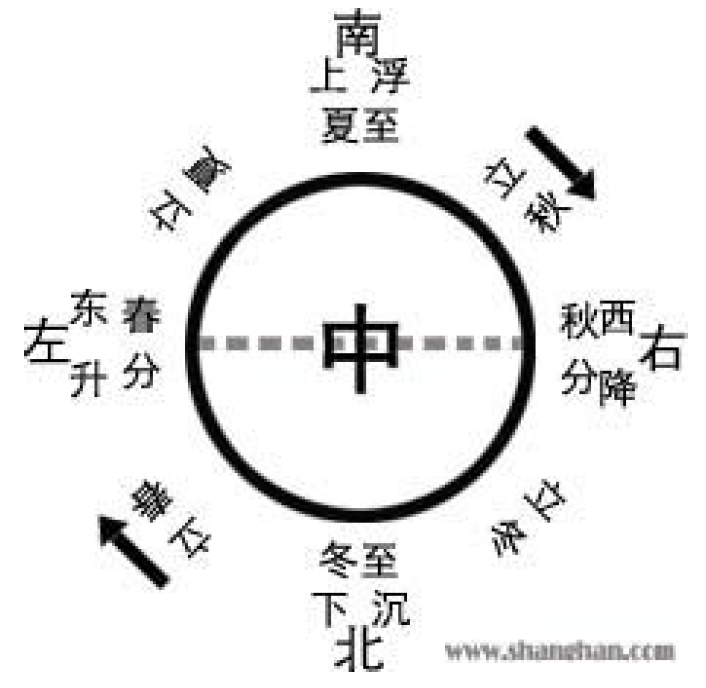
Discussing the descending, sinking, ascending, and floating of heat in plants is akin to discussing the heat’s behaviour in the atmosphere and, ultimately, within the human body. The dashed line in the diagram represents the ground in the universe and corresponds to the space between the chest and navel in the human body, specifically two inches above the navel. Heat naturally ascends and floats and does not descend or sink by itself. The force of autumn’s energy gathering leads to the descent and sinking of heat. Heat descending marks the beginning of life for living beings; if heat does not descend, it can lead to death. More details on the autumn energy gathering will be elaborated on in subsequent sections.
阴阳
一个生物所在之地,太阳射到此地面之光热,就是阳。此地面的光热已过,与光热未来之间,就是阴(伏羲画卦,—为阳卦、––为阴卦其义即此)阳性上澎,阴性下压。阳性直上,阴性直下。阴阳交合,发生爱力,彼此相随,遂成一个圆运动。阳性动,阴性静。静则沉,动则浮。
Yin and Yang
In the place where a living being resides, the sunlight that reaches and warms the ground represents yang. The period when this light and heat have passed and the new light has not yet arrived is called yin (as depicted by Fuxi in the trigrams: “—” for the yang trigram and “– –“ for the yin trigram, symbolizing this very principle). Yang naturally rises and expands, while yin naturally descends and compresses. The movement of yang is upward, while the movement of yin is downward. When yin and yang interact, they create a force of attraction, following one another and forming a circular movement.
The nature of Yang is movement, while the nature of yin is stillness. Stillness leads to sinking, while movement leads to floating.
由静而动则升,由动而静则降。升浮降沉一周,则生中气。中气者,生物之生命也。此大气的圆运动之所由来,亦即造化个体之所由成就。人秉造化阴阳圆运动之大气以有生。人的个体,即造化个体的遗传。先认识造化大气的阴阳,自能认识人体的阴阳。五行者,阴阳二气整个升浮降沉中的五种物质。行,即运动也。生物个体,皆有阴性阳性者,大气中有阴阳故也。此中医阴阳二字之来源也。造化二字,乃宇宙大气圆运动时,生育生物之称,亦即宇宙之称。
The transition from stillness to movement results in rising, and the transition from movement to stillness results in descending. The cycle of ascending, floating, descending, and sinking completes a round of movement, which generates centre qi. This centre qi is [the essence] of life in living beings. This is the origin of the circular movement of the atmosphere and the fundamental process through which individual beings are formed. Humans are endowed with life through the circular movement of yin and yang in the atmosphere. The human body is an inheritance of this cosmic individual creation.
By first understanding the yin and yang of the cosmic atmosphere, one can naturally understand yin and yang within the human body. The Five phases (Wood, Fire, Earth, Metal, Water) represent the five types of material present within the entire cycle of ascending, floating, descending, and sinking of yin and yang energies. [The Chinese term] xing (行) [translated as phases] implies movement.
All living beings possess both yin and yang natures because the atmosphere contains these forces. This explains the origin of the terms yin and yang in Chinese medicine. The concept of creation (造化) refers to the universal atmospheric movement that nurtures living beings and can also be seen as another name for the cosmos itself.
五行
一年的大气,夏气属火,太阳射到地面的热多。太阳射到地面的热,火也。热则上浮,故夏时大气热浮而属火气。夏时太阳旺于南方,故南方属火气。一日之午时,亦属火气。午时太阳的热,射到地面的多也。春分至立夏的热,称为君火。小满至小暑的热,称为相火。君相二字之义详见下文。
The Five Phases
The atmospheric conditions throughout the year align with the Five Phases. During summer, the atmosphere corresponds to fire, as the heat from the sun reaching the ground is at its peak. This heat is associated with fire. Since heat rises, the summer atmosphere is characterized by heat that floats upward, thus being classified as fire qi. In summer, the sun is at its strongest in the south, which is why the south is associated with fire qi. The noontime of a day is also linked to fire qi because the sun’s heat is most intense at this time.
The period from the spring equinox to the start of summer is called Sovereign [or Imperial] Fire (君火), while the period from Lesser Fullness of Grain (小满) to Lesser Summer-Heat (小暑) is called Ministerial Fire (相火). The meanings of Sovereign Fire and Ministerial Fire will be explained in more detail later.
秋气属金,秋时太阳往南,地面的压力渐大,天空之间,金气弥漫,大气的压力,即金气之下降也。天空的金气,至秋始显,故秋时大气凉降而属金气。造化之气,东升西降,降气旺于西方,故西方属金气。一日之酉时,亦属金气,酉时金气凉降之力独大也。天空之间,指地面之上言。金气详宇宙篇气象学的证明。
Metal is associated with autumn. During this time, the sun shifts southward, increasing pressure on the earth’s surface, and metal qi permeates the sky, signifying the descent of atmospheric pressure. The presence of metal qi in the sky becomes evident in autumn, leading to a cool and descending atmosphere that characterizes autumn as metal qi. The qi of creation (造化之气) rises in the east and descends in the west, with descending energy being most potent in the west, which is why the west is linked to metal qi. The hour of Yǒu (酉时, around 5-7 p.m.) is also associated with metal qi, as its cooling and descending force is most significant at this time.
[The term] “between the sky” refers to the space above the earth’s surface. The nature and behaviour of metal qi will be detailed further in the meteorological proofs found in the section on cosmology.
冬气属水。生物的生命,全是太阳射到地面的热所产生。今夏太阳射到地面的火热,即是来年生物生命之根。然此火热,必须经过秋时降入土下,经过冬时,藏于土下的水中,然后能生生物的生命。冬时大气沉而能藏,沉而能藏者水也。大气热则上浮,寒则下沉。故冬时大气,寒沉而属水气。南方在地面之上,北方在地面之下,故北方属水气。一日之子时,亦属水气。子时,大气沉极之时也。关于生物生命的宇宙,是上南下北。大气上浮之方为南,下沉之方为北。
Winter qi corresponds to water. The life of living beings is entirely dependent on the heat from the sun reaching the earth. The heat from the sun in the summer becomes the root of life for the following year. However, this fiery heat must descend into the earth during autumn and be stored in the water beneath the earth during winter before it can nourish life. In winter, the atmosphere sinks and has the ability to preserve; this ability to sink and preserve is characteristic of water. Warm air rises, while cold air sinks, so in winter, the atmosphere sinks due to coldness and is associated with water qi. The south is considered above the ground, while the north is considered below the ground; thus, the north is associated with water qi. The hour of Zǐ (子时, around 11 p.m. to 1 a.m.) is also linked to water qi as it marks the peak of atmospheric sinking. In the cosmic framework of life, the south is above and the north is below, with the direction of atmospheric ascent being southward and descent being northward.
春气属木。一年的大气圆运动,冬时为终,春时为始,终即始之根也。上年夏时,太阳射到地面之热,经秋时金气收而降于土下,又经冬时藏于土下的水中。火水化合,水气温暖,则往上升。此温暖之气,交春升泄出土,草木发生,故属木气。木者水中火气,由封藏而升泄之气也。
Spring qi corresponds to wood. The annual circular movement of the atmosphere ends in winter and begins anew in spring, with the end serving as the root of the beginning. The heat absorbed by the ground during the previous summer is collected by metal qi in autumn and descends into the earth, where it is stored within the water during winter. The fusion of fire and water produces warm water qi, which rises. This warmth rises during spring, breaking through the soil and initiating the growth of vegetation, thus corresponding to wood qi. Wood represents the ascending release of fiery energy from water, emerging from dormancy into activity.
中气属土。一年的大气,春升,夏浮,秋降,冬沉。故春气属木,夏气属火,秋气属金,冬气属水。升浮降沉,运动一周,而为一岁。夏秋之间,为圆运动的中气。地面的土气,居升浮降沉之中,为大气升降的交合,故中气属土气。金水木火土,大气圆运动之物质也。行,运动也。
此中医五行二字之来源也。故人身亦有春夏秋冬,亦有东南西北。
Center qi corresponds to earth. Throughout the year, the atmosphere follows the cycle of rising in spring, floating in summer, descending in autumn, and sinking in winter. Therefore, spring qi corresponds to wood, summer qi to fire, autumn qi to metal, and winter qi to water. The complete cycle of rising, floating, descending, and sinking forms a full year. Between summer and autumn lies the central qi, which is associated with the earth. The earth qi of the ground mediates the interactions of rising, floating, descending, and sinking in the atmosphere, making it the center of these transitions. Thus, central qi belongs to the earth phase. The five phases—metal, water, wood, fire, and earth—are materials within the circular movement of the atmosphere. [The Chinese term] xing (行) implies movement.
This is the origin of the term Five phases in Chinese medicine. Correspondingly, the human body experiences its own version of spring, summer, autumn, and winter, as well as its own directions of east, south, west, and north.
五行相生相克
五行物质,各有能力。木气有疏泄能力,火气有宣通能力,金气有收敛能力,水气有封藏能力,土气有运化能力,能力亦称势力,亦称作用。
春气由冬气而来,故曰水生木。夏气由春气而来,故曰木生火。长夏之气由夏气而来,故曰火生土。秋气由长夏之气而来,故曰土生金。冬气由秋气而来,故曰金生水。夏秋之间为长夏。
Mutual Generation and Control of the Five Phases
Each of the five phase substances possesses its own unique ability. Wood qi has the ability to course and discharge, fire qi perfuses, metal qi constrains, water qi stores and conceals, and earth qi transports and transforms. These abilities are also referred to as forces as well as functions.
The movement of spring qi comes from winter, hence it is said, “Water generates wood.” Summer qi follows spring, so “Wood generates fire.” The qi of late [or long] summer follows summer, so “Fire generates earth.” Autumn qi comes from the energy of late summer, hence “Earth generates metal.” Finally, winter qi comes from autumn, so “Metal generates water.” The transitional period between summer and autumn is called late summer.
收敛作用,制疏泄作用,故曰金克木。宣通作用制收敛作用,故曰火克金。封藏作用制宣通作用,故曰水克火。运化作用,制封藏作用,故曰土克水。疏泄作用制运化作用,故曰木克土。运化者,运动化合也。宣通者,宣热通散也。土克水者,土能伤水分也。
The collecting function of metal restricts the coursing and discharging function of wood, therefore it is said that “Metal controls wood.” The perfusing function of fire restricts the constraining function of metal, so “Fire controls metal.” The storing function of water restricts the perfusing function of fire, so “Water controls fire.” The transporting and transforming function of earth restricts the storing function of water, so “Earth controls water.” The coursing and discharging function of wood restricts the transporting and transforming function of earth, so “Wood controls earth.” [The term] yunhua 运化 refers to transportation and transformation, involving movement and integration. [The term] xuantong 宣通refers to the perfusion of heat, enabling its circulation and dispersal. Earth controlling water refers to its ability to reduce [or contain] water.
相生者,大气圆运动次序的先后。相克者,大气圆运动对待的平衡。相生者,补其不足。相克者,制其太过。相生相克,皆圆运动自身维持自身运动之圆而已。天人之气,和平则无病。运动圆则和平,亦和平则运动圆。相生则生,相克则平。相生相克者,中医学的生理、病理、医理之事也。一年的五行圆运动,要归纳一日看。一日的五行圆运动,要归纳一息看。一呼一吸则大气升降于人身,成一整个也。天人的天字,乃整个造化的简称。
Mutual generation represents the sequential order of the circular movement of atmospheric energy, while mutual control represents the balancing mechanism within this movement. Mutual generation supplements what is lacking, while mutual control prevents excess. Both mutual generation and control are ways in which the circular movement maintains its continuity and balance. When the qi of heaven and humanity are in harmony, there is no disease. Balanced circular movement brings peace, and peace maintains circular movement. Mutual generation promotes life, while mutual control ensures balance. These concepts form the basis of physiology, pathology, and treatment in Chinese medicine.
The annual cycle of the five-phase circular movement can be reflected in a single day, and the daily cycle can be further simplified to one breath. Each breath, encompassing one inhalation and exhalation, mirrors the rising and descending of atmospheric energy within the human body, forming a complete cycle. The term “heaven” in “heaven and humanity” refers to the entirety of nature’s creation.
六气
一年大气的圆运动。春木主生,夏火主长,秋金主收,冬水主藏,中土主化。生、长、收、藏、化,五行圆运动之成功也。六气者,风、热、暑、湿、燥、寒。乃五行运动不圆,作用偏见之气。五行各一,惟火有二,故曰六气。
Six Qi
The circular movement of atmospheric energy over a year follows a pattern where spring is governed by wood, signifying growth; summer by fire, signifying development; autumn by metal, signifying collection; winter by water, signifying storage; and centre earth signifying transformation. These five phases—growth, development, collection, storage, and transformation—represent the successful completion of the five-phase cycle.
The six qi are wind, heat, summer heat, dampness, dryness, and cold. They arise when the five-phase cycle is disrupted, reflecting an imbalance in the natural influences. While each phase corresponds to one of the five qi, fire has two variations, resulting in six distinct forms of qi.
君火运行,重在上升。相火运行,重在下降。相火由秋降入水中,再由春升上,乃为君火。而君火又随相火下降,名曰五行,其实六行。因六气各有事实,故又曰六行六气。
Sovereign fire operates with an emphasis on upward movement, while ministerial fire focuses on downward movement. Ministerial fire descends into the water during autumn and rises again during spring to become sovereign fire. Meanwhile, sovereign fire follows the ministerial fire downward. This is termed the five phases, but in fact, it is a system of six phases. Since each of the six qi has its own functional role and observable phenomena, the concept is also known as the six phases and six qi.
六行六气,是融合极密,分析不开,和平不偏的圆运动。木气偏见,则病风。君火之气偏见则病热。相火偏见,则病暑。金气偏见,则病燥。水气偏见,则病寒。土气偏见,则病湿。故六气名目,而有厥阴风木,少阴君火,少阳相火,太阴湿土,阳明燥金,太阳寒水之称也。
The six phases and six qi form a deeply integrated, inseparable, balanced circular motion that maintains harmony without bias.
- When wood qi deviates, it leads to wind diseases.
- When sovereign fire qi deviates, it causes heat diseases.
- When ministerial fire qi deviates, it leads to summer heat diseases.
- When metal qi deviates, it results in dryness diseases.
- When water qi deviates, it causes cold diseases.
- When earth qi deviates, it leads to dampness diseases.
Thus, the six types of qi are also known by specific terms:
- Jueyin Wind Wood (厥阴风木)
- Shaoyin Sovereign Fire (少阴君火)
- Shaoyang Ministerial Fire (少阳相火)
- Taiyin Damp Earth (太阴湿土)
- Yangming Dry Metal (阳明燥金)
- Taiyang Cold Water (太阳寒水)
《内经》谓在地为五行,在天为六气,在事实上,说不过去。此即五行图,加一相火,名曰五行六气,其实六行六气。阳升阴降,自然之事。阴性本降,三阴之升,阴中有阳也。阳性本升,三阳之降,阳中有阴也。
In the Inner Classic (Huangdi Neijing), it is said: “On Earth, there are the Five Phases; in Heaven, there are the Six Qi.” However, this explanation alone is insufficient. The addition of ministerial fire (相火) to the Five Phases, referred to as the Five Phases and Six Qi, in fact [should be] the Six Phases and Six Qi.
The natural pattern involves the ascending of yang and the descending of yin. The intrinsic nature of yin is to descend, but the ascending of the three yin indicates the presence of yang within yin.
The intrinsic nature of yang is to ascend, yet the descent of the three yang indicates the presence of yin within yang.
金木水火,分主四维。相火土气,同主中宫。中宫在地面之际,四维距地面较远。六行六气的圆运动,四节一气。
The phases—metal, wood, water, and fire—preside over the four cardinal directions, while ministerial fire and earth qi co-govern the central palace. The central palace corresponds to the surface of the Earth, while the four cardinal directions are more distant from the Earth. The circular motion of the Six Movements and Six Qi follows the sequence of four nodes for each qi phase:
大寒、立春、雨水、惊蛰属初之气。春分、清明、谷雨、立夏属二之气。小满、芒种、夏至、小暑属三之气。大暑、立秋、处暑、白露属四之气。秋分、寒露、霜降、立冬属五之气。小雪、大雪、冬至、小寒属六之气。
The Major Cold (大寒), Beginning of Spring (立春), Rain Water (雨水), and Awakening of Insects (惊蛰) correspond to the initial qi [period].
The second qi [period] corresponds to Spring Equinox (春分), Pure Brightness (清明), Grain Rain (谷雨), and Beginning of Summer (立夏).
The third qi [period] includes Lesser Fullness of Grain (小满), Grain in Ear (芒种), Summer Solstice (夏至), and Lesser Heat (小暑).
The fourth qi [period] encompasses Greater Heat (大暑), Beginning of Autumn (立秋), End of Heat (处暑), and White Dew (白露).
The fifth qi [period] includes Autumn Equinox (秋分), Cold Dew (寒露), Frost’s Descent (霜降), and Beginning of Winter (立冬).
Finally, the sixth qi [period] covers Lesser Snow (小雪), Greater Snow (大雪), Winter Solstice (冬至), and Lesser Cold (小寒).
此时令病发生之根源也。圆运动的天人一气,时令病上,最为显着。内伤杂病,亦属六气,特不似时令病关系生死之速耳。因时令病,乃整个六气分散,中气消灭极易,故死甚速也。
These [divisions of the qi periods] mark the root and source of seasonal illnesses. The circular movement of qi that unifies heaven and humanity is most apparent in these seasonal diseases. While internal damage and complex diseases also relate to the Six Qi, they do not generally lead to the same rapid consequences as seasonal diseases. Seasonal illnesses are caused by the disruption of the six qi, which easily leads to the depletion of central qi, resulting in rapid fatality, due to the easy dissipation of qi balance when influenced by the changing seasons.
地面上属阳,地面下属阴。初气之时,大气由寒而温。地下水中所封藏经秋收来的阳热,动而上升。此阳热与水化合,是为木气。木气者,一年之阳根也。大寒节气,当阴极之时,故称厥阴。厥者,极也。木气主动,动而不通,则成风。故称厥阴风木。
The surface of the Earth is associated with yang, while below the surface is associated with yin. During the initial qi period, the overall climate transitions from cold to warm. The yang heat stored in underground water during autumn begins to rise in early spring, combining with water to generate wood qi. This wood qi represents the source of yang for the entire year. The solar term Major Cold (大寒) marks the extreme of yin, hence it is referred to as Jueyin (厥阴), with “jue” meaning “extreme.” Wood qi governs movement, and if is impeded, it will generate wind. As such, this is referred to as Jueyin Wind-Wood (厥阴风木).
二之气,亦从地下阴位升出地面,即木气上升之气也。此时大气较热,不似厥阴之阴极,故称少阴。木气上升之气,即水中气藏上年秋时下降的阳气。此阳气,由地下升至地上,照临大宇,光明四达,上升之象,有如君位,故称君火。此时大气由温而热,又称热火。
The second qi [period] arises from the underground yin position and manifests as the upward rising of wood qi. At this time, the atmosphere is relatively warm, not reaching the extreme of yin as seen in Jueyin, thus it is referred to as Shao [lesser] yin (少阴). The upward rising of wood qi represents the yang qi stored in water, which descended during the autumn of the previous year. This yang qi rises from the ground to the surface, illuminating the vast universe and spreading its brightness, which resembles the behavior of the sovereign; therefore, it is called Sovereign fire (君火). At this point, the atmosphere transitions from warm to hot, also referred to as heat-fire (热火).
少阳相火三气之时,地面上阳热盛满。经暮夜大气之凉降,降入地面下之水中。然当暑热上腾之时,旋降旋升。地下水中,为生物生命之所从出。此阳热实为生命之本,地面上阳热盛满,地而下所得阳热不多,故称少阳。此阳热降入地下水中,以生中气。中气旋转,则上下交清,有如相臣之职,故称相火。此火不降,暑热熏蒸,又称暑火。
During the third qi period of Shaoyang (少阳) and Ministerial Fire (相火), the surface of the Earth is filled with abundant yang heat. As the coolness of night descends, this cool air moves down into the underground water. However, when the summer heat rises, it alternates between descending and ascending. The water underground serves as the foundation for life. This yang heat is fundamentally the source of life; with the surface having an abundance of yang heat and the underground having less, it is termed Shao [lesser] yang. This yang heat descends into the underground water in order to generate central qi. When the central qi rotates, it creates a harmonious balance between the upper and lower realms, much like the role of a minister, hence it is called Ministerial Fire. This fire does not descend, and when the summer heat lingers, it is also referred to as Summer-Heat Fire.
太阴湿土四气之时,地面上阳热盛满。地面下旧有的阳气,亦升上来。地面上非常之热,地面下非常之寒。热属阳,寒属阴。大气阴多,故称太阴。为在水下则生气,火在水上则生湿。此时地面上阳热盛满,尚未降入土下。寒热相逼,湿气濡滋。土气在升降之交,故称湿土。
During the fourth qi period of Taiyin damp earth, the surface of the ground is filled with abundant yang heat. The previously stored yang energy from below the surface also rises up. The surface experiences extreme heat, while underground, it remains extremely cold. Heat is associated with yang, and cold is associated with yin. Since there is an excess of yin in the atmosphere, it is referred to as Tai [greater] yin. In water, there is qi; when fire is above water, it generates dampness. At this time, the surface is filled with yang heat that has yet to descend into the earth. The clash of heat and cold leads to the drenching and proliferation of dampness. The earth’s qi is at the point of rising and falling, thus it is termed damp earth.
阳明燥金地面上为阳位。五气之时,地面上盛满的阳热,经秋气之收敛,正当下降。中土之下,阳气充足。湿气已收,大宇光明,阳盛而明,故称阳明。金气当旺,湿也收则燥热气结。此时地面上空的金气,压力极大,故称燥金。
Yangming dry metal occupies the yang position on the surface. During the fifth qi period, the yang heat that fills the surface, influenced by the autumn’s collection, begins to descend. Below centre earth, yang qi is abundant. Dampness has receded, the great universe is bright, and yang is flourishing and luminous; hence it is called Yangming [Yang brightness]. [When] metal qi is vigorous and dampness has also receded, dryness and heat qi bind. At this time, the atmospheric metal qi is under great pressure, hence it is called dry metal.
太阳寒水六气之时,地面上的阳热,经秋气之收敛,全行降入土下的水中。造化之气,中下为本。中下阳多,故称太阳。此阳热降入水中,水即将他封藏不泄。此时大气降压,水外即寒。水外已寒,则水内阳藏,故称寒水。
During the sixth qi period of Taiyang cold water, the yang heat from the surface, having been gathered by autumn, completely descends into the water underground. The qi of creation has its roots in the lower regions. [Since] yang is copious below the centre, it is thus referred to as Tai [greater] yang. This yang heat descends into the water, where it is stored and not discharged. At this time, the atmospheric pressure drops, and the external water becomes cold. When it is cold outside, it means the yang is stored within the water, hence it is called cold water.
五行的运动圆,合成一气。木升金降,木不病风,金不病燥。水升火降,火不病热,不病暑水不病寒。土运于中,土不病湿。运动不圆,升降不交,各现各气,则病风、热、暑、湿、燥、寒,病者,大气病也。人身之气,亦如是也。
The circular movement of the five phases forms a single qi. Wood ascends [while] metal descends; [when] wood does not [suffer from] wind disease, metal [will not suffer] from dryness disease. Water ascends [while] fire descends; [when] fire does not [suffer from] heat or summer-heat disease; water [will not suffer] from cold disease. [When the] earth moves in the center; the earth [will not suffer] from dampness disease. If the movement is not circular and ascending and descending do not interact, each [phase] manifests its own qi, leading to diseases such as wind, heat, summer heat, dampness, dryness, and cold—these are diseases of the atmosphere. The qi of the human body is also like this.
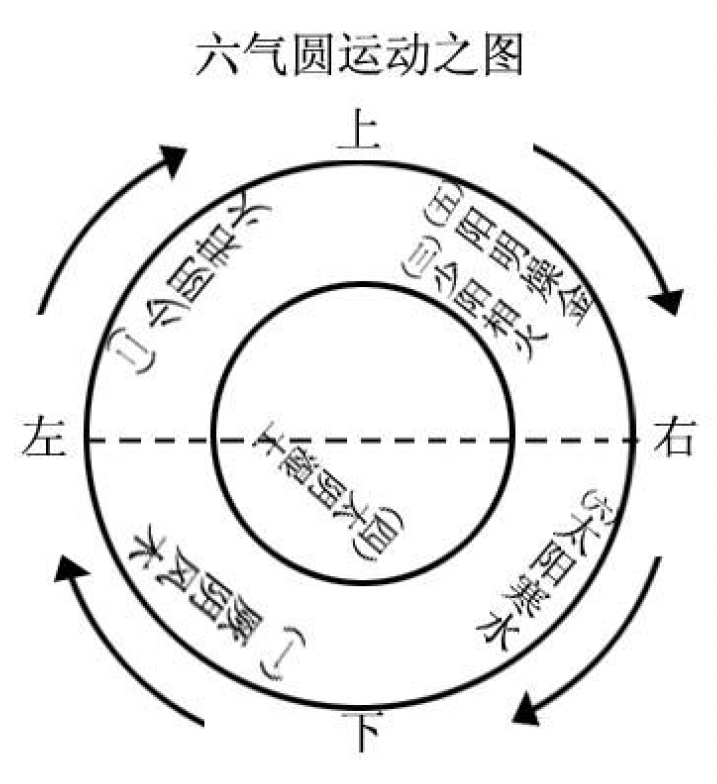
初气之时,宜养木气。二气之时,宜养火气。三气之时,宜补相火之气。四气之时,宜养土气。五气之时,宜养金气。六气之时,宜补水气。相火下降于水中,为君火之始气。君火者,相火之终气,君火又随相火下降也。
In the period of initial qi, it is suitable to nourish wood qi. During the second qi period, it is suitable to nourish fire qi. In the third qi, it is suitable to supplement ministerial fire qi. During the fourth qi, it is suitable to nourish earth qi. In the fifth qi, [one should] nourish metal qi. In the sixth qi, it is suitable to supplement water qi. The ministerial fire descending into the water marks the beginning of the sovereign fire.The sovereign fire is the culmination of the ministerial fire’s qi, and it descends together with the ministerial fire.
_________________________________________________________
Peng Chengzu (1871-1949), courtesy name Ziyi, was a member of the Bai ethnic group from Heqing, Yunnan. His father served as an official in Guizhou, where Peng Ziyi was born and raised in a family with a strict academic environment. As he grew older, he pursued studies with renowned scholars in Guizhou, developing a wide range of knowledge. Peng had a natural passion for medicine and delved deeply into medical studies. Later, he traveled to Beijing, where he served as a physician at the Imperial Medical Institute during the late Qing Dynasty. This position allowed him access to extensive medical archives and renowned medical texts in the capital.

Peng Ziyi’s book, Circular Movements in Ancient Chinese Medicine, builds upon the ideas from The ‘Sisheng Xinyuan’ text by Huang Yuanyu, an imperial physician of the Qianlong era in the Qing Dynasty. Huang’s work focused on the concept of the circulation and rotation of central qi, rising and descending in cycles. Peng Ziyi extended this concept by introducing the idea of “circular movements of rotating axles” as a view of Qi transformation. His book explains the principles of life movement within the human body and the foundational concepts of disease treatment in Chinese medicine through clear and straightforward reasoning.
 Eran Even, Ph.D., Dr. TCM.