On the Therapeutic Principles and Clinical Applications of Wumei Wan

Gao Tisan 高体三
Department of Formula Studies, Henan College of Chinese Medicine

Henan Chinese Medicine Journal, December 1978

Translated by Eran Even

In recent years, increasing numbers of physicians have used Wumei Wan from the Shanghan Lun to treat biliary ascariasis, achieving remarkable clinical results. Consequently, many people have come to regard Wumei Wan simply as the representative formula for expelling parasites. In reality, expelling parasites is only one of its functions and does not fully reflect the therapeutic capabilities of the formula.

In order to inherit, develop, and further advance the medical heritage of our country, thereby achieving the goal of “making the ancient serve the present,” I believe it is necessary to further investigate the therapeutic principles and clinical applications of Wumei Wan. In my opinion, such an investigation must begin with the following points.

I. The Physiology and Pathology of Jueyin Must Be Understood Through the Relationships of the Three Yin Channels of the Foot

Both traditional medical theory and clinical practice fully demonstrate the intimate relationship among the three yin channels of the foot. Concepts such as “Yi and Gui share the same source” (乙癸同源), “Spleen and Kidney Yang deficiency,” and the statement, “When disease is seen in the Liver, one knows that it will transmit to the Spleen; therefore, one should first strengthen the Spleen,” all describe the physiological and pathological relationships among these three systems.

The three yin channels of the foot refer to the Foot Jueyin Liver, Foot Shaoyin Kidney, and Foot Taiyin Spleen. Wumei Wan is one of the representative formulas of the Jueyin Liver channel. To fully understand its composition, therapeutic principles, and range of clinical applications, one must study it through the interrelationship of the Liver, Spleen, and Kidney. Only then can the full therapeutic significance of Wumei Wan be appreciated.

The opening line of the Jueyin chapter of the Shanghan Lun states:

When disease is in Jueyin, there is wasting thirst, Qi surges upward to strike the Heart, heat and pain in the Heart, hunger without desire to eat; if food is taken, vomiting of roundworms occurs; after purgation, diarrhea continues unabated.

Judging from the patterns described in this passage, it clearly encompasses more than a disorder confined solely to the Liver channel. It also includes the persistent diarrhea resulting from Spleen and Kidney deficiency cold, together with wasting thirst arising from upward blazing heat. Only by considering the interrelationship of the Liver, Spleen, and Kidney can one arrive at a comprehensive understanding of Wumei Wan.

The Foot Jueyin Liver governs wind and wood and occupies the position between water and fire. Water is the mother of the Liver, while fire is its child. Liver wood arises from Kidney water and gives rise to Heart fire, thereby assisting water in ascending to nourish fire.

The Foot Shaoyin Kidney transforms Gui water upward to communicate with Heart fire. Under normal physiological conditions, Kidney water ascends to unite with fire, while Heart fire descends to unite with water. Water and fire mutually support one another, Yin and Yang are rooted in each other, and the two qi harmonize. Consequently, fire does not flare upward and water does not descend into coldness. This is the physiological state of health.

The mutual communication of water and fire, however, depends to a certain extent upon the Liver’s ability to assist the ascent of water. If Liver wood fails to assist water in ascending to nourish fire, the characteristic Jueyin pattern of upper heat and lower cold develops.

The Liver belongs to wood. Whether cold or heat predominates depends upon the relative strength of opposing influences. When the influence of the child predominates, heat develops; when the influence of the mother predominates, cold develops. heat represents the potential for recovery, whereas reversal cold indicates the approach of serious disease. Between these two extremes, the strength or weakness of the Central Qi is the decisive factor.

When the Central Qi is abundant, Yang is restored. When the Central Qi declines, cold reversal develops.

The Central Qi belongs to Earth.

The Foot Taiyin Spleen governs Damp Earth. When healthy, no pathology arises, but once diseased it is characterized by Dampness and deficiency. Under normal circumstances, the Spleen not only transforms food and fluids and generates Qi and Blood, but also nourishes Liver wood and restrains Kidney water.

When Taiyin deficiency develops, however, the Spleen is no longer able to nourish wood or control water. Instead, water overacts upon Earth while wood is deprived of nourishment. Therefore, deficiency cold patterns of both the Liver and Kidney are closely related to deficiency of the Taiyin Central Earth.

Although Wumei Wan was established for disorders of the Jueyin Liver channel, the inclusion of Renshen, Fuzi, and Ganjiang is intended to supplement Spleen deficiency and warm Kidney Yang, thereby harmonizing the water and Earth of the Spleen and Kidney so that they may nourish and support the growth of Liver wood.

From this it is evident that the Wumei Wan pattern is by no means confined solely to the Liver channel. Rather, it bears a very close relationship to Taiyin Spleen deficiency and Shaoyin Kidney cold.

As the saying goes:

“The Liver belongs to wood. It is the residence of the generating Qi and the storehouse of Blood. Its nature is firm yet it delights in free coursing. It must be nourished by water and supported by Earth before it can fulfill its function of growth and development.”

This statement likewise illustrates the intimate relationship among the Liver, Spleen, and Kidney. Accordingly, the Wumei Wan pattern of the Jueyin channel necessarily involves both the pathology and therapeutic methods of the Taiyin and Shaoyin systems.

II. The Therapeutic Principles of Wumei Wan Must Be Understood Through the Physiology and Pathology of the Foot Jueyin Liver

The Liver governs ascending movement and prefers free coursing. It depends upon the supportive functions of the Spleen and Kidney so that it has an adequate source of nourishment, allowing it to flourish and grow freely with wood in harmony and wind remaining calm. The cold pattern of the Jueyin zang is closely related to the inability of the deficient Spleen and Kidney to nourish and support it.

Accordingly, Wumei is used as the chief herb because of its sour and warm nature, which enters the Liver. It is combined with the sweet, acrid, and warm Guizhi and Danggui to nourish the Blood and soothe the Liver. Renshen, which enters the Spleen, supplements the Central Qi and strengthens Spleen Earth. Fuzi, Ganjiang, Xixin, and Huajiao, all intensely warming herbs, warm Kidney Yang and dispel cold of the zang organs.

Since the Liver is unable to assist water in ascending to nourish fire, the pattern manifests as upper heat with wasting thirst. Therefore, Huanglian and Huangbo are added as bitter and cold medicinals to drain fire and treat the heat above.

This demonstrates that Wumei Wan primarily supplements the Liver and nourishes the Blood, secondarily warms the Spleen and Kidney, and additionally clears the upper heat. As for the formula’s ability to expel parasites, this will be discussed below.

III. The Clinical Applications of Wumei Wan Must Be Understood Through Its Therapeutic Principles

Supplementing the Liver, nourishing the Blood, expelling parasites, strengthening the Spleen, warming the Kidney, and clearing heat above constitute the fundamental therapeutic principles underlying Wumei Wan.

Because Liver disease readily overacts on the Spleen, Zhang Zhongjing stated in the Jingui Yaolue:

“When disease is seen in the Liver, know that it will transmit to the Spleen; therefore, one should first strengthen the Spleen.”

This makes it clear that in the cold pattern of the Jueyin zang, Wumei Wan must include medicinals that supplement the Center and strengthen the Earth.

Likewise, in discussing the treatment of Shaoyin disease, Zhang Zhongjing wrote in the Shanghan Lun:

“When Shaoyin receives Yang, it is favorable.”

This further illustrates that when Kidney water is cold, it is unable to nourish Liver wood and will inevitably overact upon Spleen Earth, leaving Liver wood without a source of nourishment. Therefore, in treating the cold pattern of the Jueyin zang, Wumei Wan necessarily includes herbs that warm the Kidney.

The Liver normally assists water in ascending to nourish above. When disease prevents this function, upper heat develops; consequently, Wumei Wan also contains herbs that clear the upper region.

Because cold within the zang organs is unfavorable for the survival of roundworms, and because roundworms prefer warmth, they flee the cold below and move upward toward the heat above, producing vomiting of roundworms. Although Wumei Wan contains no typical vermicidal herbs, an examination of the flavors of its ingredients reveals a definite antiparasitic effect.

Wumei is sour, and sourness restrains the worms.

Xixin and Huajiao are acrid, and acrid herbs drive out the worms.

Huanglian and Huangbo are bitter, and bitterness directs the worms downward.

For this reason, Wumei Wan has demonstrated remarkable efficacy in the treatment of biliary ascariasis.

Nevertheless, one must not overemphasize its antiparasitic action while overlooking its much broader functions of supplementing the Liver and nourishing the Blood, strengthening the Spleen, and warming the Kidney.

Accordingly, in addition to treating ascariasis, Wumei Wan may be modified for disorders arising from deficiency cold of the Liver, Spleen, and Kidney, including cold-type dysmenorrhea, deficiency-cold abdominal pain, chronic adnexitis, leukorrhea due to deficiency cold, chronic enteritis, chronic colitis, chronic dysentery, deficiency-cold stomach pain, chronic prostatitis, impotence, enuresis, sciatica, chronic trigeminal neuralgia, rectal prolapse, uterine prolapse, and similar disorders. Clinical experience has shown that the formula is frequently effective in such conditions.

This demonstrates that Wumei Wan is not merely an excellent prescription for biliary ascariasis, but an important formula for a wide range of chronic disorders resulting from deficiency cold of the Liver, Spleen, and Kidney.

Conclusion

In summary, the key to understanding both the therapeutic principles and the indications of Wumei Wan lies in approaching it through the relationship of the three yin channels of the foot. Once the physiology and pathology of the Liver, Spleen, and Kidney are understood, the rationale underlying the composition of Wumei Wan becomes clear.

Only then can one avoid the mistaken belief that Wumei Wan is merely a formula for expelling parasites while neglecting its powerful actions of supplementing the Liver, nourishing the Blood, strengthening the Spleen, and warming the Kidney.

In short, Wumei Wan was designed for roundworm disorders occurring in the presence of deficiency cold of the Liver, Spleen, and Kidney, rather than for all cases of roundworm disease regardless of constitutional state.

Therefore, in addition to treating zang cold with roundworm reversal, it may be modified for many chronic disorders arising from deficiency cold of the three yin systems. When upper heat is absent, Huanglian and Huangbo may be omitted.

Because it simultaneously employs both warming and cooling medicinals, Wumei Wan is particularly effective for patterns of upper heat and lower cold. Its clinical applications are broad and deserve continued attention and investigation.

Owing to the limitations of my knowledge and clinical experience, my understanding is undoubtedly incomplete. I respectfully welcome correction from my colleagues.

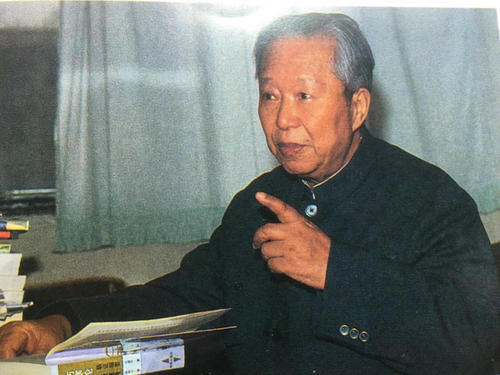
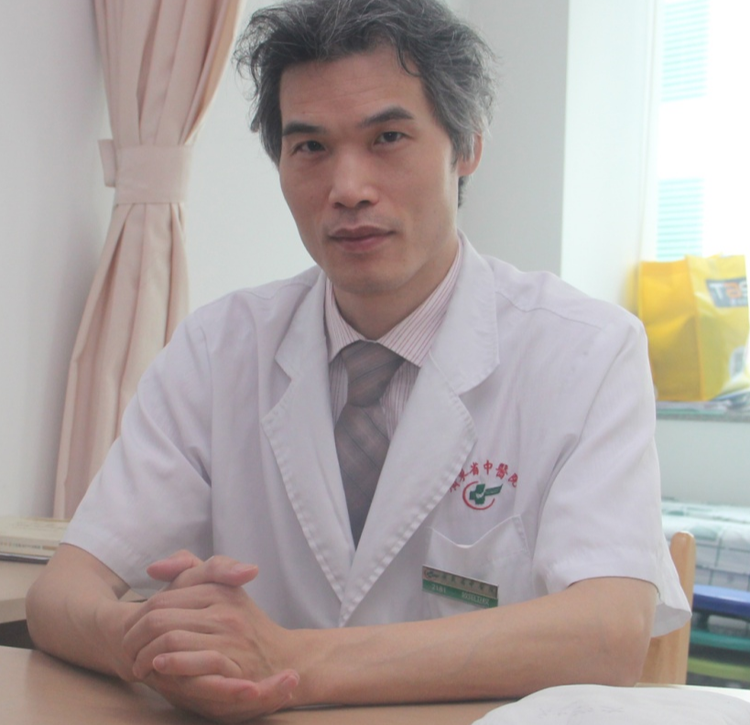
Gao Tisan 高体三 (November 1920–2011) was a renowned Chinese medicine physician, educator, and scholar from Yuanchang Village, Qinghua Township, Wolong District, Nanyang County, Henan Province (now part of Dengzhou City). A member of the Chinese Communist Party, he served as Professor and Chief Physician at Henan College of Chinese Medicine. He was a director of the Henan Branch of the China Association of Traditional Chinese Medicine, a member and consultant for the editorial committee of the Chinese medicine textbook series for the five central-southern provinces, a member of the Fifth and Sixth Henan Provincial Committees of the Chinese People’s Political Consultative Conference (CPPCC), and was recognized by the Ministry of Health, the Ministry of Personnel, and the State Administration of Traditional Chinese Medicine as one of China’s nationally renowned senior Chinese medicine experts and clinical mentors. He is regarded as the founding figure of the Formula Studies (Fangji) discipline at Henan College of Chinese Medicine.

Gao inherited his family’s medical tradition from an early age, studying under his father. In 1943, he established his own medical practice in Deng County. In 1958, he was recommended for advanced study at the Henan Provincial School of Chinese Medicine, where he remained after graduation in 1959 to join the faculty, serving as Head of the Department (later Division) of Formula Studies. He retired in 1990 but was subsequently reappointed to continue clinical practice at the National Medicine Clinic of the Third Affiliated Hospital of Henan College of Chinese Medicine.

Over more than sixty years of clinical practice, Gao developed the academic theory of “Water Warm, Earth Harmonized, Wood Flourishes” (水暖土和木达). He emphasized pattern differentiation based on the three yin channels of the foot (Taiyin, Shaoyin, and Jueyin) and was especially skilled in the use of classical formulas (Jingfang) and warming medicinals for the treatment of difficult and complex disorders.

He authored numerous textbooks and monographs, including Lecture Notes on Chinese Medical Formula Studies, Lecture Notes on Common Diseases in Chinese Medicine, Clinical Chinese Materia Medica, Treatment Methods and Formulas, and A New Interpretation of the Tangtou Gejue (Songs of Decoctions), the latter of which has been reprinted multiple times. His development of the Weijinkang Health Beverage (维金康保健饮料) received the Second Prize for Scientific and Technological Progress from the Henan Provincial Department of Light Industry in 1993. In 2008, he was awarded the Lifetime Achievement Award for Traditional Chinese Medicine in Henan Province by the Henan Provincial Administration of Traditional Chinese Medicine. His academic theories and clinical experience were also incorporated into China’s Tenth and Eleventh Five-Year National Key Science and Technology Support Programs.

On Xù Mìng Tāng (Life-Restoring Decoction)

Translated from Huáng Huáng’s Jīngfāng Formula Presentations 经方方证

Xù Mìng Tāng (Life-Restoring Decoction) from Gujin Luyan (Ancient and Modern Records of Proven Prescriptions)

Xù Mìng Tāng is an ancient formula for fēngfèi (wind paralysis).1 Traditionally it is classified as a wind-dispelling, cold-scattering prescription. It has the functions of restoring motor function, improving speech, relaxing the muscles, treating numbness, and relieving cough and wheezing. The presentation of Xù Mìng Tāng is characterized by paralysis or weakness of the limbs, numbness, and aphasia, and is most often seen in sudden-onset disorders.

I. Classical Formula

Má Huáng, Guì Zhī, Dāng Guī, Rén Shēn, Shí Gāo, Gān Jiāng, and Gān Cǎo, 3 liǎng each;

Chuān Xiōng, 1 liǎng;

Xìng Rén, 40 pieces.

Combine the nine ingredients. Decoct in one dǒu of water and reduce to four shēng. Take one shēng warm. A slight sweat should result. Lightly cover the back and sit leaning against a support. Recovery follows once sweating occurs. If sweating does not occur, administer another dose. There are no dietary restrictions, but exposure to wind should be avoided.

II. Classical Formula Presentation

Treats wind fēi strike [where] the body is unable to control itself, an inability to speak, clouded confusion and a lack of pain sensations, or hypertonicity preventing one from turning over to the side. Also treats those who can only lie prone and cannot lie flat, with cough, panting, and swelling of the face and eyes.

(Jīnguì Yàolüè, Chapter 5, addendum formula)

1. “The body is unable to control itself” (身体不能自收)

This generally refers to quadriplegia or hemiplegia. Commonly seen in:

  • Post-stroke sequelae
  • Cerebral infarction
  • Guillain-Barré syndrome
  • Acute myelitis
  • Hypokalemic paralysis
  • Radiculitis

2. “Inability to speak” (口不能言)

This refers to aphasia, where the patient cannot answer questions. It likely describes central aphasia caused by damage to language centers in the brain. Common causes include:

  • Stroke
  • Brain tumors

3. “Clouded confusion and a lack of pain sensations” (冒昧不知痛处)

Màomèi (冒昧) describes mental confusion.

  • Mào (冒) depicts a hat covering the eyes.
  • Mèi (昧) means obscured or unclear.

In the Waitai Miyao, the phrase is followed by “does not recognize people,” suggesting impairment of consciousness.

This represents mild cerebral dysfunction.

“Lack of pain sensations” refers to sensory impairment: when stimulated with a sharp object, the patient cannot localize the stimulus or withdraw appropriately. This corresponds to numbness and sensory loss, often seen in:

  • Radiculitis
  • Guillain-Barré syndrome

4. “Hypertonicity preventing one from turning over to the side.” (拘急不得转侧)

This describes increased muscle tone and associated neuropathic pain. Commonly seen in:

  • Parkinsonian syndromes
  • Post-stroke sequelae

The hypertonicity reflects upper motor neuron damage (“spastic paralysis”). Flaccid paralysis generally indicates lesions of the spinal cord or other lower motor neuron disorders.

5. “Can only lie prone and cannot lie flat, with cough, panting, and swelling of the face and eyes” (但伏不得卧,咳逆上气,面目浮肿)

This refers to:

  • Cough and wheezing
  • Orthopnea (inability to lie flat)
  • Sitting upright to breathe
  • Facial edema

Seen in:

  • Chronic obstructive pulmonary disease (COPD)
  • Cor pulmonale with heart failure
  • Bronchial asthma

The formula contains elements of both Má Xìng Shí Gān Tāng and Má Huáng Tāng, well-known formulas for relieving wheezing. Like Mù Fáng Jǐ Tāng, it employs Guì Zhī, Rén Shēn, and Shí Gāo, herbs commonly used in pulmonary-heart disease.

The key terms in the classical text encompass many of the major clinical manifestations of neurological disease. The formula may be viewed as a combination of Má Huáng Tāng, Má Xìng Shí Gān Tāng, and Dà Qīng Lóng Tāng. However, the addition of Dāng Guī, Chuān Xiōng, and Rén Shēn gives it a distinctive affinity for neurological disorders.

Traditional commentators explained:

“It is not merely disturbance by pathogenic qi, but also decline of the true qi.”

— You Yi

“A specialized formula for treating stroke.”

— Mo Meishi

“Wind enters and blocks the pores, obstructing the movement of ying and wei. Wind is often accompanied by cold. Initially it enters through the skin and gradually penetrates inward. Prolonged stagnation transforms into heat; heat damages yin. When yin is damaged, the zang-fu are no longer nourished internally, nor can nourishment reach the body externally. Thus arise loss of motor control, inability to speak, confusion, and loss of sensation.”

— Chen Xiuyuan

The pathological basis of the formula is closely related to disorders of the central nervous and motor systems.

The text’s emphasis on respiratory distress also deserves attention, suggesting usefulness in severe pulmonary disease.

III. Suitable Patient Characteristics

This is primarily an emergency formula and does not require a specific constitutional type. However, when used for chronic conditions over longer periods, characteristic patient features can be considered.

1. Robust Build with Yellow-Dusky Complexion (黄黯壮实)

Suitable for patients who are:

  • Solidly built and sturdy
  • Yellow-dusky rather than flushed
  • Rough, dry skin
  • Puffy or fatigued appearance
  • Not prone to sweating

Symptoms are often triggered by fatigue, exposure to cold, or sudden invasion of wind-cold.

2. Slippery-Wet Tongue Coating (水滑苔)

Suitable when:

  • Tongue coating is white, greasy, or moist/slippery
  • Excess saliva or phlegm is present
  • Urination is clear and copious

3. Prominent Neurological Symptoms

Suitable for patients with:

  • Headache
  • Neck and upper back soreness
  • Muscular tension
  • Joint pain
  • Slowed reactions
  • Aphasia
  • Slurred or difficult speech
  • Difficulty walking
  • Difficulty swallowing
  • Wheezing with phlegm sounds

Use cautiously or avoid in patients with:

  • Marked heat intolerance
  • Profuse sweating
  • Significant arrhythmias
  • Markedly elevated blood pressure
  • Prostatic enlargement with urinary difficulty

IV. Applicable Disorders

This formula is most commonly used for neurological diseases affecting either the central or peripheral nervous systems.

Consider it when the presentation includes:

  • Acute flaccid weakness or paralysis
  • Increased muscle tone with neuropathic pain
  • Sudden impairment of speech or swallowing
  • Cough, wheezing, facial edema, or excessive salivation

1. Wind Paralysis (风痱)

An ancient disease category characterized by:

  • Limb paralysis
  • Numbness
  • Aphasia

It resembles modern conditions such as:

  • Myelitis
  • Acute inflammatory polyneuropathy (Guillain-Barré syndrome)
  • Certain forms of brainstem encephalitis

“Wind fēi is when one suddenly cannot speak, the mouth is clenched, and the limbs become impaired and rigid.”

(Beiji Qianjin Yaofang, Vol. 8)

The original instructions state:

“If sweating occurs, recovery follows; if not, administer another dose.”

Thus, mild sweating is considered a sign that the formula is taking effect.

If sweating does not occur, the dosage of Má Huáng may be increased.

According to Huang Shipei, tolerance to Má Huáng varies greatly among individuals; dosing should begin conservatively and increase gradually.

2. Stroke (脑卒中)

The formula presentation corresponds well to acute stroke symptoms such as:

  • Facial deviation
  • Hemiplegia
  • Altered consciousness
  • Difficulty speaking or understanding speech
  • Visual disturbances
  • Difficulty walking
  • Dizziness
  • Loss of balance and coordination

Use cautiously in:

  • Severe hypertension
  • Cerebral hemorrhage

Hu Xishu cautioned:

“One should be cautious when using this formula clinically for stroke.”

3. Parkinson’s Disease

The phrases:

“The body is unable to control itself” and “Hypertonicity preventing one from turning over to the side” closely resemble Parkinsonian features such as:

  • Increased muscle tone
  • Shuffling gait

Most appropriate in patients who are:

  • Robustly built
  • Have a moist, slippery tongue coating
  • Maintain a normal appetite

For excessive salivation, combine with Wú Zhū Yú Tāng.

V. Formula Differentiation

1. Xù Mìng Tāng vs. Má Huáng Tāng

Both may be used for:

  • Stroke
  • Hemiplegia
  • Aphasia

However, the neurological manifestations of Xù Mìng Tāng are considerably more severe.

2. Xù Mìng Tāng vs. Chái Hú Jiā Lóng Gǔ Mǔ Lì Tāng

Both can treat movement disorders.

  • Xù Mìng Tāng treats:
    • “The body is unable to control itself” and “Hypertonicity preventing one from turning over to the side”
  • Chái Hú Jiā Lóng Gǔ Mǔ Lì Tāng treats:
    • “The whole body feels heavy and cannot turn over”

However:

  • Chái Hú Jiā Lóng Gǔ Mǔ Lì Tāng is more commonly used in patients with depression and insomnia.
  • Fullness in the chest, vexation, and fright are characteristic signs.

These symptoms are generally absent in Xù Mìng Tāng, whose defining feature is sudden disease onset.

VI. Reference Dosage

  • Má Huáng 15 g
  • Guì Zhī 15 g
  • Dāng Guī 15 g
  • Rén Shēn 15 g
  • Shí Gāo 20 g
  • Gān Jiāng 15 g
  • Gān Cǎo 15 g
  • Chuān Xiōng 10 g
  • Xìng Rén 15 g

Decoct in 1000 mL water and reduce to 400 mL.

Take in 2–3 divided doses throughout the day.

A mild sweat is considered the ideal therapeutic response.

If treatment is required for longer than seven days, the dosage may be reduced by half.

  1. Nigel Wiseman translates the character fèi 痱 as ‘wind disablement’, where he goes on to say, “Wilting, and loss of the use of the limbs without pain and with loss of mental faculties. The língshū states, ‘when disablement is the disease, and there is no generalized pain, the limbs cannot contract, cognitive faculties are not seriously confused, and speech is faint, the condition can be treated.’ This passage would indicate that disablement is a sequela of wind stroke.” (Wiseman, Practical Dictionary of Chinese Medicine, Pleco edition.)   ↩︎

The Poetry of Wáng Wéi 王维

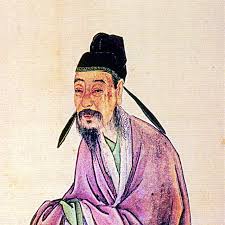
Wáng Wéi 王维 (693 or 694 or 701 – 761), courtesy name Mójí 摩诘, also known as Mójí Jūshì 摩诘居士, was originally from Hédōng Púzhōu 河东蒲州 (modern Yongji, Shanxi). He later moved to Jīngzhào Lántián 京兆蓝田 (modern Lantian, Shaanxi), and his ancestral home was Qíxiàn 祁县 in Shanxi. He was a poet and painter of the Tang dynasty.

He came from the Hedong branch of the Tàiyuán Wángshì 太原王氏, known specifically as the Hédōng Wángshì 河东王氏. At nineteen, he traveled to Jingzhao prefecture to sit for the examinations and won first place. At twenty-one, he passed the jìnshì 进士 examination. Over the years, he served as Yòu Shíyí 右拾遗 (Right Remonstrator), Jiǎnchá Yùshǐ 监察御史 (Censor), and Héxī Jiédùshǐ Pànguān 河西节度使判官 (Assistant to the Military Commissioner of Héxī).

During Emperor Xuánzōng’s Tiānbǎo era, he was appointed Lìbù Lángzhōng 吏部郎中 (Director in the Ministry of Personnel) and Gěishìzhōng 给事中 (Palace Aide). When Ān Lùshān 安禄山 captured Cháng’ān 长安, Wáng Wéi  was forced to accept an official position under the rebel regime. After Cháng’ān was retaken, he was demoted to Tàizǐ Zhōngyǔn 太子中允 (Assistant to the Heir Apparent), but later rose to Shàngshū Yòuchéng 尚书右丞 (Vice Minister of the Ministry of Works). He died in the second year of the Shàngyuán 上元 era (761), in the seventh month, at the age of sixty-one.

Wáng Wéi  not only practiced Chán 禅 Buddhism and studied Daoist teachings (Zhuāngxué 庄学, Xìndào 信道), but also excelled in poetry, calligraphy, painting, and music. His poetic fame was especially prominent during the Kāiyuán 开元 and Tiānbǎo 天宝 eras, and he was particularly skilled in five-character verse (wǔyán 五言).

Many of his poems describe landscapes and pastoral life; together with Mèng Hàorán 孟浩然, he was known as “Wáng–Mèng 王孟” and was honored with the title “Poet-Buddha” (Shīfó 诗佛). His painting, especially his landscape style, reached great heights, and later generations regarded him as the founder of the Southern School of landscape painting (Nánzōng shānshuǐhuà zhī zǔ 南宗山水画之祖).

Sū Shì 苏轼 said of him:
“Taste Mojie’s poems and there are paintings within them; view Mojie’s paintings and there is poetry within them.”

More than 400 of his poems survive today. Representative works include “Xiāngsī 相思” (Longing) and “Shānjū Qiūmíng 山居秋暝” (Autumn Evening in the Mountains). His extant writings include Wáng Yòuchéng Jí 《王右丞集》 and Huàxué Mìjué 《画学秘诀》.

1.《鸟鸣涧》
鸟鸣涧
人闲桂花落,
夜静青山空。
月出惊山鸟,
时鸣春涧中。


Birds Calling in the Ravine
With people at leisure, osmanthus blossoms fall;
In the still night, green mountains lie empty.
When the moon rises, it startles the mountain birds,
Who now and then cry out in the spring ravine.

Commentary
In the first two lines, the poem’s focus settles on the words “fall” and “empty.” “Fall” portrays the poet’s unhurried, leisurely state of mind—only then can one sense the tiny osmanthus blossoms drifting down without a sound. “Empty” depicts the vast, far-reaching atmosphere created by the stillness of night.
The next two lines shift from silence to sound: “startled” and “crying” further express the tranquility of the moonlit night and the emptiness of the valleys. The most interesting point is that through the birds’ cry, the desolate quiet of the first lines suddenly gives rise to a pulse of life, filling the poem with vitality amidst its serenity. This is precisely the elegant, leisurely attitude toward life that Wáng Wéi  pursued.

2.《杂诗》
君自故乡来,应知故乡事。
来日绮窗前,寒梅着花未?


Miscellaneous Poem
You come from my old hometown—
You must know the affairs of home.
Tell me, before the embroidered window,
Has the winter plum begun to bloom?

Commentary
This is a uniquely conceived poem of homesickness. The poet expresses intense longing for home through concern for the plum blossoms there. All four lines are the traveler’s questions—implying deep care for his homeland.
He could ask about many things, yet he chooses the plum outside the window. This seemingly small and casual question contains boundless longing and affection. The “winter plum” is no longer just a plant before the window, but a symbol of all that is worth remembering at home—an embodiment of homesickness that feels intimate, natural, and full of meaning.

3.《相思》
红豆生南国,春来发几枝。
愿君多采撷,此物最相思。


Longing
Red berries grow in the southern land—
In spring, how many new branches appear?
I hope you gather them in plenty,
For this is the seed of deepest longing.

Commentary
This poem was written for the famous singer Li Guinian. In only twenty characters, it expresses the poet’s heartfelt affection. After the An Lushan Rebellion, Li Guinian wandered in the south, and it is said he often sang this poem, deeply moving all who heard it.
The first two lines naturally and sincerely introduce the red berries. The last two lines convey feeling through metaphor—intimate and touching. Centered entirely on the symbol of the red berry, the poem expresses longing with simplicity and warmth, creating a lasting emotional resonance.

4.《九月九日忆山东兄弟》
独在异乡为异客,每逢佳节倍思亲。
遥知兄弟登高处,遍插茱萸少一人。


Thinking of My Brothers on the Double Ninth
Alone in a strange land as a lonely guest,
Every festive day my thoughts of home double.
From afar I know my brothers have climbed the heights;
Among the dogwood sprigs they wear, one person is missing—me.

Commentary
This is a festival poem expressing longing for family.
The first two lines describe the poet’s inner feelings during the festival. In the first line, one “alone” and two uses of “foreign/strange” portray a deep sense of isolation and unfamiliarity, making the second line’s “doubled homesickness” especially affecting. It resonates with anyone who has spent a holiday far from home, touching the heart and becoming a timeless line.
The last two lines use the custom of climbing heights and wearing dogwood on the Double Ninth Festival to imagine the poet’s brothers back home. This not only shows his longing for family but also emphasizes his own disappointment and loneliness—deepening the poem’s theme.

5.《渭城曲》 / 《送元二使安西》
渭城朝雨浥轻尘,客舍青青柳色新。
劝君更尽一杯酒,西出阳关无故人。


Song of Weicheng (also Seeing Yuan Er Off to Anxi)
Morning rain at Weicheng dampens the light dust;
At the travelers’ lodge, the willows look freshly green.
I urge you—drink one more cup of wine,
For once you pass west of Yang Gate, there will be no old friends.

Commentary
The poem depicts the emotional scene of parting with a close friend. The first two lines describe the beauty of the homeland after rain; the last two express the affection and reluctance at parting.
Artistically, the opening lines serve as a gentle prelude, while the final lines reveal the true theme. The poet skillfully conveys sorrow and tenderness with restraint, making the emotions sincere and warm. Thus this poem has been passed down through the ages and is loved by generations.

Liú Dùzhōu Case Studies

With my upcoming Liú Dùzhōu book release, I felt it would be apt to share a couple random cases from this brilliant physician. These cases do not appear in my book, but were ones I found during my many deep dives and Liú Dùzhōu rabbit holes. Enjoy!

Case of Dysmenorrhea
Patient: Li, female, 45 years old. Initial consultation on May 5, 1993.

History:
The patient developed dysmenorrhea one year prior after undergoing an induced abortion. During each menstrual period, she experienced severe, cold pain in the lower abdomen that was unrelieved by analgesics. Her menstrual cycle was delayed, with scanty, dark-colored blood containing clots. This menstrual period began yesterday. She also presented with dry mouth, chapped lips, dizziness, soreness in the waist, weakness in the legs, and fatigue when lifting. The tongue was dark, and the pulse was deep.

Diagnosis:
This was diagnosed as a condition of deficiency and cold in the Chong and Ren channels, with blood stasis obstruction.

Treatment:
The treatment principle was to warm the channels, dispel cold, eliminate blood stasis, and nourish the blood. The prescription was derived from the Jīnguì yàolüè formula Wēn Jīng Tāng:

wüzhūyú 8g

guìzhī 10g

shēngjiāng 10g

dāngguī 12g

báisháo 12g

chuānxiōng 12g

dǎngshēn 10g

zhìgāncǎo 10g

mǔdānpí 10g

ējiāo (dissolved separately) 10g

bànxià 15g

màidōng 30g

Outcome:
After taking five doses, the cold pain in the lower abdomen was significantly relieved. The same prescription was continued for five more doses. By the next menstrual period, the abdominal pain did not recur. From that point forward, her menstruation became regular and without discomfort. (Selected Clinical Case Studies of Liú Dùzhōu)

Commentary:
Wēn Jīng Tāng is effective for treating dysmenorrhea. Renowned Hangzhou physician Qiu Xiaomei once recalled:
“I was fortunate to work alongside the famous Zhejiang physician Ye Xichun. Ye’s profound and unique medical skills provided me with many valuable insights. For example, when treating cold-induced dysmenorrhea, the routine application of Wēn Jīng Tāng often proved effective. However, there were cases where it was ineffective.” (The Path of Renowned TCM Physicians)

This highlights that even when using Wēn Jīng Tāng, it is crucial to match the formula to the correct pattern. In this case, Dr. Liú Dùzhōu documented not only the patient’s localized symptoms (such as delayed menstruation, severe cold pain in the lower abdomen, and scanty dark menses) but also systemic characteristics such as dry lips, a dark tongue, and a deep pulse, along with the abortion as the inducing factor.

Case of Neurotic Disorder and Irritability

Patient: Cao, a 72-year-old female, who first consulted on October 26, 1995.
The patient had been experiencing persistent irritability for two years, with a recent worsening trend.
Western medicine diagnosed it as a neurotic disorder, and she was given sedatives and anxiolytics, but there was no improvement. She then sought traditional Chinese medicine treatment.

Presenting Symptoms: The patient complained of intense irritability, which was unbearable. Her family members were sympathetic and cautious, but she could not express herself or felt misunderstood. She became agitated and, during severe episodes, felt relief only after hitting her chest and abdomen with a stick. She felt a rising sensation from the navel to the chest, which worsened the irritability. She also experienced abdominal bloating with a feeling of obstruction. Additional symptoms included insomnia, restlessness, nausea, poor appetite, irregular bowel movements, and yellow urine. Her tongue was red at the tip, with a greasy coating, and the pulse was wiry and slippery.

Diagnosis: A pattern of fire stagnation in the chest and abdomen, with downward pressure on the stomach and intestines.

Treatment Strategy: Soothe stagnation, clear heat, regulate qi, and reduce fullness.
Prescription: Zhīzǐ Hòupò Tāng

zhīzǐ 14g

zhǐshí 10g

hòupò 15g.

7 doses.

Follow-up: After 7 doses, the patient reported a 50% reduction in irritability. Her chest and abdomen felt clearer, and her mood stabilized. She was able to sleep at night, and her appetite improved. The treatment was highly effective, and the patient continued with 7 more doses. Upon follow-up, she still had symptoms of sleep disturbances, dry mouth, a bitter taste, and yellow urine, indicating that heat had not fully resolved.
The prescription was then changed to Chái Qín Wēn Dǎn Tāng [Wēn Dǎn Tāng plus cháihú & huángqín) combined with Zhīzǐ Hòupò Tāng to clear phlegm-heat and treat the remaining symptoms. After one month, the patient fully recovered.
(From Liú Dùzhōu Lin Zhen Yan An Xuan (Selected Clinical Cases of Liú Dùzhōu))

Note: The difference between Zhīzǐ Hòupò Tāng and Zhīzǐ Shí Tāng lies in the abdominal symptoms. The former is indicated when abdominal symptoms like bloating and constipation are present, while the latter is primarily used for chest-related symptoms like chest oppression and cough. Zhīzǐ Hòupò Tāng and Xiǎo Chéng Qì Tāng both contain zhǐshí and hòupò, which treat abdominal fullness and pain. The key difference is that zhīzǐ and dàhuáng have distinct effects: Zhīzǐ clears irritability, while dàhuáng is used to purge and clear heat. Therefore, Zhīzǐ Hòupò Tāng is more suitable for chest obstruction and irritability, while Xiǎo Chéng Qì Tāng is better for constipation and abdominal pain. The patient’s detailed symptoms of irritability and abdominal fullness illustrate the application of Zhīzǐ Hòupò Tāng for heat-related disturbances and its ability to address both physical and emotional symptoms.

acupuncture in port coquitlam

Case of Coldness in the Tips of the Toes Followed by Abdominal Discomfort and Diarrhea (Lóu Shàokūn)

The patient is a 50-year-old male farmer from Yongqiang. He has always been healthy and has never been ill until the last 5 years. Recently, he frequently experiences coldness in his toes, especially in the summer. Whenever his toes feel cold, he also feels discomfort in his abdomen, which is followed by diarrhea. This year, the symptoms have become more frequent, and his hands and feet have started to experience spasms, which he never had before. This has caused him some anxiety. He has visited many doctors who all diagnosed him with intestinal dysfunction, but the treatments did not bring noticeable results. The patient is also a distant relative of mine, so he came to seek my help.

First Consultation (July 10, 2005):
Upon examination, the patient reported the symptoms mentioned above, along with night sweats in winter, spontaneous sweating in summer, and a lack of thirst. However, there were no significant abnormalities found in his pulse or tongue. Abdominal examination revealed thin, weak abdominal muscles. Based on this, I suspected a Guìzhī Tāng pattern. The patient’s symptoms of cold feet in summer leading to abdominal discomfort reminded me of a Japanese Kampo [physicians] experience, where he said: “Cold feet in summer causing abdominal pain should be treated with Guìzhī Jiā Fùzǐ Tāng.” Therefore, I prescribed 7 doses of Guìzhī Jiā Fùzǐ Tāng, replacing shēngjiāng with gānjiāng, essentially combining Guìzhī Tāng and Sì Nì Tāng.

Follow-up Consultation (July 17, 2005):
After taking the medicine for one week, the patient reported feeling very comfortable and as if he had met a long-lost friend. The coldness in his toes, abdominal discomfort, and diarrhea had also improved. Since the prescription had been effective, I continued with Guìzhī Jiā Fùzǐ Tāng for another 7 doses.

Follow-up Consultation (July 24, 2005):
After another week of medication, the patient’s condition continued to improve. The spasms in his hands and feet had disappeared, and the symptoms of cold toes, abdominal discomfort, and diarrhea had significantly improved. However, spontaneous sweating continued. Based on the symptoms, I added Yù Píng Fēng Sǎn to the original formula and instructed the patient to take it for two weeks before stopping the medication to observe the results.

After a month of continuous treatment with the combined formula of Guìzhī Jiā Fùzǐ Tāng and Yù Píng Fēng Sǎn, the patient’s symptoms disappeared, and he stopped the medication. A year later, when I met his family, I learned that his condition had been completely cured.

Note:
In classical Chinese medicine, it’s important to pay attention to experience-based maxims. As Gě Hóng from the Jin Dynasty mentioned in Bàopǔzǐ: “In the transmission of medical secrets, words are not written down, only passed down through oral formulas.” In traditional herbal medicine, treatment is based on patterns and symptom differentiation. The treatment in this case is simple and effective when considering the pattern and maxim: “Cold feet in summer causing abdominal pain should be treated with Guìzhī Jiā Fùzǐ Tāng.”

In this case, the “coldness in the toes” symptom might suggest the use of xìxīn, which treats retained fluids and dampness. However, the patient’s coldness, spontaneous sweating, and diarrhea were more in line with the Sì Nì Tāng pattern, so I added fùzǐ and replaced shēngjiāng with gānjiāng to match the correct pattern.

Two Cases On The Use of Táohé Chéng Qì Tāng In Severe Psychiatric Disorders

Case of Blood Amassment Induced Madness by Cao Yingfu 曹颖甫

Shen Shiwan’s younger sister, a frail young woman under the age of twenty, suddenly suffered a fright while out shopping. Upon returning home, she descended into madness—attacking anyone she encountered with seemingly boundless strength.

Several days passed without improvement, and I was called to examine her. By then, her condition had persisted for seven or eight days, with no signs of relief. Upon inquiry, I learned that she had not had her menstrual period for two months. Seizing an opportunity while she slept, I entered her room to examine her. Her pulse was deep and tight, and her lower abdomen appeared distended.

I stepped outside and told Shen Shiwan, “This is a case of blood amassment. A strong purgative will cure it.” I prescribed Táohé Chéng Qì Tāng as follows:

  • Táorén 1 liang
  • Dàhuáng 5 qian
  • Mángxiāo 2 qian
  • Zhìgāncǎo 2 qian
  • Guìzhī  2 qian
  • Zhǐshí 3 qian

The next day, I returned to check on her. She had passed a large amount of dark blood, her madness had completely subsided, she showed no signs of exhaustion, and she could even drink porridge. She was now ashamed to face others and refused to come out. (From Jingfang Shiyan Lu – Empirical Records of Classical Formulas)

Commentary:

The key diagnostic markers for Táohé Chéng Qì Tāng include “[patient] appears as if mad” and a “tense bound lower abdomen,” which strongly indicate its use in psychiatric disorders related to blood stagnation. The case aligns closely with classical descriptions—particularly the immediate menstrual discharge of dark purple blood after treatment, a vivid demonstration of the classical principle: “when blood is discharged, the illness will resolve.”

Hormonal changes can often lead to premenstrual symptoms such as irritability, insomnia, headaches, and cognitive issues, which frequently improve after menstruation. This phenomenon, referred to as blood amassment (xu xue 蓄血), remains a fascinating area for further study.

The prescription is quite potent and purgative. If hòupò were added, it would become a combination of Táohé Chéng Qì Tāng and Dà Chéng Qì Tāng. Interestingly, Dà Chéng Qì Tāng is also used in neurological conditions, including delirium, incoherent speech, hallucinations, clouded vision, and severe restlessness, often with more pronounced abdominal fullness and distension.

Case of Shock-Induced Immobility and Chest Oppression by Yè Júquán 叶橘泉

A businessman, known for his cautious and timid nature, had a habitual fondness for alcohol. At the time, Suzhou was under Japanese occupation. One midnight, Japanese military police, accompanied by local collaborators, conducted a household inspection. Terrified, the man was left speechless, eyes wide in shock, unable to respond. He was suddenly slapped across the face by the military police and collapsed to the ground, lying rigid and unconscious, appearing as if he had suffered a stroke.

I was invited to examine him. His pulse was thin and wiry, with a slippery sensation upon deep palpation. His face was flushed, tears welled up in his eyes, and though he appeared to have sensation when touched, he remained speechless and motionless in a rigid supine posture. His pupillary reflexes were normal, and no signs of hemiplegia were present, but his feet were icy cold, his rectus abdominis was tense, and there was a palpable mass in the lower abdomen. He had not had a bowel movement for several days.

I prescribed Táohé Chéng Qì Tāng with the addition of niúxī and chuānxiōng. After taking the formula, he had a bowel movement, his feet became warm, and he soon let out a deep sigh, moaning as if relieved of an immense weight. He then spoke for the first time, saying that he had felt a crushing pressure on his chest.

A second dose was given, after which his stool contained traces of blood. Upon examination, it was found that he had preexisting hemorrhoids, which had started bleeding. I then reduced the dosage and continued treatment for several more doses, leading to a full recovery. (From Zhongguo Bainian Bainming Zhongyi Linchuangjia Congshu – Yè JúquánA Century of Renowned Chinese Physicians: Yè Júquán)

Commentary:

This case illustrates a shock-induced immobility with clear signs of blood stasis and psychological disturbance. Although the patient did not exhibit violent mania, his mental dysfunction was undeniable. The physician skillfully identified abdominal tension, a palpable lower abdominal mass, and prolonged constipation as key indications for Táohé Chéng Qì Tāng, demonstrating a flexible application of classical formulas.

Two key diagnostic markers stand out in this case:

  1. Flushed face with cold lower limbs – a hallmark external manifestation of blood stasis, which can serve as a visual clue for selecting Táohé Chéng Qì Tāng.
  2. Post-treatment rectal bleeding – This reinforces the classical principle that “blood will discharge after taking the formula”, not only in the form of menstrual bleeding in women but also through lower gastrointestinal or even urinary tract bleeding in certain cases. However, this effect is not universally observed in all patients.

Hán Shān’s Legacy: Poetry, Philosophy, and Buddhist Influence

Hanshan 寒山 (dates of birth and death unknown), courtesy name and sobriquet also unknown, was a native of Chang’an (modern-day Xi’an, Shaanxi) and lived in seclusion in the Tiantai Mountains of eastern Zhejiang for over 70 years, passing away at the age of over 100. According to modern day poet Red Pine, Han Shan was born in the ancient town of Hantan at the western edge of the Yellow River floodplain, about 300 kilometres east of Chang’an, and his family only moved to Chang’an when he was little.1 Scholars generally place his life during the Tang Dynasty (618–907 CE), though specific details about his life are elusive due to his reclusive lifestyle and the mythical aura surrounding him.

A renowned poet-monk of the Tang Dynasty, Hanshan hailed from an aristocratic family but failed multiple attempts at the imperial examinations. Eventually, he renounced worldly pursuits, became a monk, and after the age of 30, withdrew to the Tiantai Mountains, living in seclusion and adopting the name “Hanshan” (Cold Mountain).

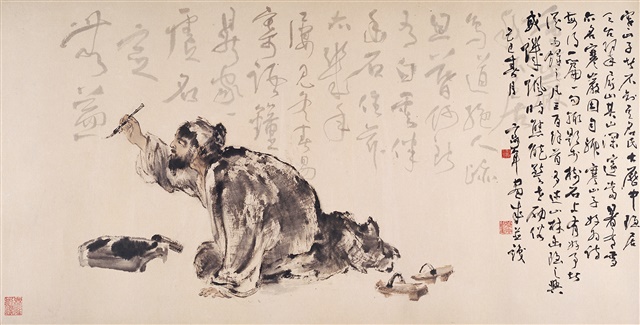
According to Yan Zhenfei’s Examination of Hanshan’s Life Story, supported by historical texts such as Northern History and Book of Sui, Hanshan was the son of Yang Wen, a descendant of the Sui royal family. Due to jealousy and ostracism within the imperial court, combined with the influence of Buddhist thought, he retreated to the Cold Cliffs of the Tiantai Mountains. He was known for his eccentric lifestyle, wearing a birch-bark hat, tattered clothing, and wooden clogs. He enjoyed playing with children, spoke freely and unpredictably, and was difficult for others to understand. He often visited the Guoqing Temple in Tiantai, where he befriended two monks, Fenggan and Shide. Hanshan would collect leftover temple food in bamboo tubes to sustain himself in his mountain home.

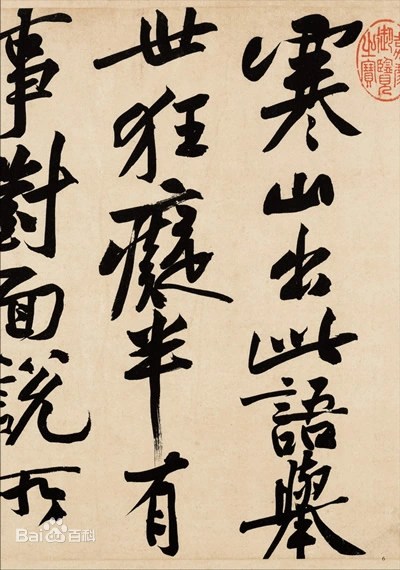
Hanshan frequently wrote poems and gathas (short Buddhist verses) on the rocks and trees of the wilderness. His poetry was straightforward, capturing the joys of mountain life and expressing Buddhist ideals of detachment, life’s wisdom, and compassion for the poor. He also criticized social norms and injustice. Han Shan’s poems focus on Buddhist and Daoist themes, with self-reflections and commentary on Tang society. These stylistic and thematic elements align with the intellectual and spiritual currents of the Tang era. His works were later compiled into the Collected Poems of Hanshan in three volumes, with 312 poems preserved in the Complete Tang Poems. In the Yuan Dynasty, his works were introduced to Korea and Japan and later translated into languages like Japanese, English, and French.

Legend has it that the Taoist that first collected Han Shan’s poetry, was a man named Xu Lingfu, who had moved to the Tiantai mountains in 815 to practice and live in seclusion as well and stayed for his remaining days. Based on several writings, we can ascertain that the two met sometime after 825 and before Xu’s death in 841.

This legendary poet, initially overlooked by society, gained increasing recognition and global dissemination in the 20th century. As one of his poems proudly declares:

Some laugh at my poetry,
 [yet] my poems unite with the classical odes.
 No need for Zheng’s commentary,
 Nor Mao’s annotations to shine.2

Han Shan is more often regarded as a spiritual figure than a historical one. He is depicted as a “laughing hermit” embodying Zen wisdom, with his poetry serving as a timeless bridge to his thought rather than a concrete record of his life.
The following are a few personal favourites that I feel capture the essence of Han Shan’s style and voice. All translations are my own.

我居山,勿人識。白雲中,常寂寂。

I reside in the mountains unaware of anyone, among the white clouds, always in solitude. 


寒山深,我稱心。
純白石,勿黃金。
泉聲響,撫伯琴。
有子期,辨此音。

Deep in cold mountain, I am content.
Pure white stones are not gold. 
The springs sound, and I gently pluck a qin.
If Ziqi3 were here, he’d recognize these sounds.


寒山子,長如是;
獨自居,不生死.

Master cold mountain, is always like this,
residing alone, free from birth or death.4

重岩我卜居,鸟道绝人迹。
庭际何所有,白云抱幽石。
住兹凡几年,屡见春冬易。
寄语钟鼎家,虚名定无益

In the layered cliffs, I chose my dwelling,
Where bird paths are cut from human presence.
What is at my courtyard edge?
White clouds embrace the shrouded stones.
I have lived here many years, observing the changes of the seasons.5
I send word to households with bells and tripods,6
Empty titles are of no benefit.

欲得安身处,寒山可长保。
微风吹幽松,近听声愈好。
下有斑白人,喃喃读黄老。
十年归不得,忘却来时道。

If you desire a place to calm your body, cold mountain can keep you protected.
A gentle breeze blows hidden pines, the closer you come, the more exceptional it sounds.
Below a grey haired man mutters [the words] he has read of Huang-Lao.7
For ten years he has not returned home, forgotten the path from which he came.

独卧重岩下, 蒸云昼不消。
室中虽暡靉, 心里绝喧嚣。
梦去游金阙, 魂归度石桥。
抛除闹我者, 历历树间瓢。

Alone I lie beneath the layered cliffs,
Steaming clouds, fail to disperse throughout the day.
Though the room is dim and misty,
My heart-mind is free from all clamor.
In dreams, I float within the imperial palace,
My ethereal soul returns, crossing the stone bridge.
I cast away things that disturb me,
Especially the gourd among the trees.

凡读我诗者, 心中须护净。
悭贪继日廉, 谄曲登时正。
驱遣除恶业, 归依受真性。
今日得佛身, 急急如律令。

All who read my poems,
Must protect and purify their heart-mind.
Let grudging and greed be purified daily,
And flattery and fawning be corrected at once.
Drive away and eliminate evil conduct,
Take refuge and receive your true nature.
Attain the Buddha’s body today—
Swiftly, swiftly, as the law commands.

家有寒山詩,
勝汝看經卷。
書放屏風上,
時時看一遍。

Having Hanshan’s poems at home
Surpasses your reading of scrolls.
Write them down upon a screen,
And read it through from time to time.

吾心似秋月,
碧潭清皎潔。
無物堪比倫,
教我如何說。

My mind is like the autumn moon,
A clear pond, pure and bright.
Nothing in the world compares—
How can I find the words to describe it?

  1. Red Pine, The Collected Songs of Cold Mountain (Port Townsend: Copper Canyon Press, 2000), 13.  ↩︎
  2. Han Shan is referring to the Shijing (Classic of Poetry) here and is insinuating that his poetry is easier to read, hence commentaries are unnecessary. Zheng and Mao were the standard commentaries on the Shijing↩︎
  3. This is a reference to Zhong Ziqi (钟子期), a renowned Guqin (ancient Chinese seven-string plucked instrument) musician from the State of Chu during the Spring and Autumn Warring periods. Zhong Ziqi was known for his acute listening skills and deep sensitivity to music, capturing the emotions and psychological depth behind melodies. The Ziqi-style Guqin is said to have been designed in his honor, characterized by a straight and deep neck with a half-moon shape. ↩︎
  4. A reference to Samsāra, the cycle of birth and death or re-birth and re-death.  ↩︎
  5. While the text literally says spring and winter, this can be translated simply as seasons.  ↩︎
  6. This is an ancient reference to wealthy families and households.  ↩︎
  7. Huang-Lao is an early school of Daoist thought and an important branch of Daoism that advocates active engagement with the world. It applies the philosophy of traditional reclusive Daoism to governance, aiming to achieve national prosperity and military strength. The school is named after its association with the Yellow Emperor (Huangdi) and the veneration of Laozi. Huang-Lao Daoism later became the foundation of Daoism as a religious tradition. Followers of Laozi claimed to represent the teachings of the Yellow Emperor and also revered Yi Yin and Jiang Taigong. They promoted the principles of tranquility and non-action (wu wei), avoiding interference with the people and allowing the populace to “self-transform,” thereby bringing peace and stability to the world. ↩︎

Chaihu Guizhi Ganjiang Tang [柴胡桂枝干姜汤] in the treatment of skin disorders

伤寒论六经辨证与方证新探——经方辨治皮肤病心法

欧阳卫权著

The following translation is taken from Ouyang Weiquan’s ‘Exploration of Cold Damage Six-Conformation Pattern Differentiation and Formula Presentations – Jingfang Approach to the Identification and Treatment of Skin Diseases.’ 

Chaihu Guizhi Ganjiang Tang [柴胡桂枝干姜汤]

皮肤病辨治心法

1.不论何种皮肤病、何种皮损,凡见太阴里虚寒证又见上热表现者,可考虑本方证。

2.年轻女性面部痤疮、脂溢性皮炎患者,使用本方证机会较多,常合用当归芍药散。

3.系统性红斑狼疮经长期激素治疗,常表现出本方证,临床对证用之,可迅速使皮损消退,改善症状。且坚持服用,各项狼疮指标多能转为正常。

4.其他如荨麻疹、慢性湿疹、银屑病等,皆有使用机会。

Approach to Identifying and Treating Skin Diseases

  1. Regardless of the type of skin disease or lesion, if there is a presentation of interior cold deficiency in the Taiyin channel along with symptoms of heat in the upper body, this formula can be considered.
  2. This formula is frequently used for young women with facial acne or seborrheic dermatitis and is often combined with Dang Gui Shao Yao San.
  3. Patients with systemic lupus erythematosus (SLE) who have undergone long-term corticosteroid treatment often present symptoms corresponding to this formula. Clinically, using this formula based on the diagnosis can quickly reduce skin lesions, alleviate symptoms, and, with consistent use, normalize various lupus-related indicators.
  4. Other conditions such as urticaria, chronic eczema, and psoriasis may also benefit from this formula.

医案实录

1.系统性红斑狼疮(柴胡桂枝干姜汤合当归芍药散)

杨某,女性,51岁,2005年5月13日初诊。系统性红斑狼疮

(SLE)病史13年。一直在风湿科、内科等中西医治疗,病情较稳定,现服泼尼松用量10mg/d。但患者四肢关节痛、颈、背痛不能缓解已2年余。现双肘、腕、指关节及双膝、踝关节疼痛、颈、背痛。稍怕冷,纳可,口稍干不欲饮,饮则喜温,小便少。舌暗红苔白,脉沉细。处方柴胡桂枝干姜汤合当归芍药散加味:

柴胡10g,桂枝9g,干姜4g,黄芩10g,甘草5g,花粉15g,牡蛎(先煎)20g,当归10g,白芍10g,川芎4g,茯苓15g,白术10g,泽泻10g,葛根12g,7剂。

Case Study

Systemic Lupus Erythematosus (SLE) Treated with Chai Hu Gui Zhi Gan Jiang Tang Combined with Dang Gui Shao Yao San

Yang, female, 51 years old. Initial consultation: May 13, 2005.
History of systemic lupus erythematosus (SLE) for 13 years. Previously treated with both Western medicine and Traditional Chinese Medicine in the rheumatology and internal medicine departments, with relatively stable disease progression. Currently taking 10 mg/day of prednisone.
However, the patient had been experiencing unrelieved joint pain in the limbs, neck, and back for over two years. Symptoms included pain in the elbows, wrists, finger joints, knees, and ankles, along with neck and back pain. She reported slight sensitivity to cold, normal appetite, slight dry mouth with no desire to drink, preference for warm drinks, and reduced urination. Tongue was dark red with a white coating, and the pulse was deep and thin.

Prescription:

Chai Hu Gui Zhi Gan Jiang Tang combined with Dang Gui Shao Yao San with modifications:

  • Chai Hu 10g
  • Gui Zhi 9g
  • Gan Jiang 4g
  • Huang Qin 10g
  • Gan Cao 5g
  • Tian Hua Fen 15g
  • Mu Li (pre-cooked) 20g
  • Dang Gui 10g
  • Bai Shao 10g
  • Chuan Xiong 4g
  • Fu Ling 15g
  • Bai Zhu 10g
  • Ze Xie 10g
  • Ge Gen 12g

Seven doses were prescribed.

患者服后感觉效果非常好,又自购药服12剂。药后明显好转,四肢关节及颈背痛基本消失,不觉怕冷,精神较佳,口干明显,舌暗红,苔中黄,脉细。前方加生石膏20g。上方服至2005年7月15日。诉服后关节痛全消,无其他不适,精神佳。遂改泼尼松为5mg/d。前方去石膏,继服巩固。

After taking the formula, the patient reported significant improvement. She obtained an additional 12 doses on her own. After taking the formula her joint pain in the limbs and neck/back had almost completely disappeared. Cold sensitivity was no longer noticeable, her energy levels had improved, and her dry mouth had markedly lessened. Her tongue was dark red with a yellowish coating, and her pulse was thin. 20g ofShi Gao was added to the previous formula.

The patient continued this treatment until July 15, 2005. By then, joint pain was completely resolved, and no other discomfort was reported. Her energy levels remained good. The dosage of prednisone was reduced to 5 mg/day. The prescription was adjusted by removing Shi Gao and continued as a consolidation treatment.

【按】

柴胡桂枝干姜汤见《伤寒论》第147条:“伤寒五六日,已发汗而复下之,胸胁满微结,小便不利,渴而不呕,但头汗出,往来寒热,心烦者,此为未解也,柴胡桂枝干姜汤主之。”为治热郁少阳,枢机不利,又兼太阴脾寒,水饮内伏之病变。胡希恕以此方合当归芍药散治疗SLE属血虚水盛、邪郁少阳证者多有效。笔者临床观察,SLE经西药激素控制稳定后常现本方证,依证用药确有效验。

Commentary:

The formula Chai Hu Gui Zhi Gan Jiang Tang originates from the Shang Han Lun, Clause 147, where is says:

“In cold damage that has lasted five or six days, sweating has already been promoted followed by purgation, and there is fullness and mild congestion in chest and ribs, with inhibited urination, thirst but no vomiting, and only the head is sweating, with alternating cold and heat, and heart vexation, this means that [the pattern] has not yet resolved, and Chaihu Guizhi Ganjiang Tang governs.”

 This formula addresses Shaoyang depressed heat with inhibition of the pivot mechanism combined with Taiyin spleen cold and internal deep-lying water-rheum. Hu Xishu frequently combined this formula with Dang Gui Shao Yao San to treat SLE presenting with blood deficiency, exuberant water, and Shaoyang depressed heat, with notable efficacy.

The authors own clinical observations suggest that after systemic lupus erythematosus (SLE) is stabilized with corticosteroid treatment, symptoms often align with the pattern corresponding to this formula presentation. Using the formula according to the pattern has proven to be effective.

Typical Abdominal Diagnosis Cases: Da Chai Hu Tang and Tao He Cheng Qi Tang Case Example

Original Work by Keisetsu Ōtsuka, with translation [from Japanese to Chinese] and commentary by Wang Ningyuan: Kampo and Abdominal Diagnosis

Primary Gangrene of the Left Big Toe

The patient is a 52-year-old male with a good complexion and obesity.

Two years prior, he began experiencing pain in the left big toe, which was diagnosed as primary gangrene.
At the same time, there was swelling and hardness near the left lower abdomen close to the iliac fossa, accompanied by tenderness. After being examined by a renowned surgeon, exploratory laparotomy was performed but no abnormal lesions were found.

Initial Consultation: November 7, 1925

  • Pulse: Left side was deep and choppy; right side was deep and small.
  • Blood Pressure: 112/70 mmHg.
  • Symptoms: The left dorsal artery of the foot was undetectable. The left big toe appeared purplish, with blackened toenails. The degree of pain fluctuated and worsened after exertion, significantly impacting sleep due to the pain.

Abdominal Diagnosis 

On the right side, there was fullness and discomfort in the chest and hypochondrium. In the lower left abdomen, at the site of the previous surgery, there was resistance and tenderness.

The patient had bowel movements once a day, but they were not smooth.

I considered the resistance and tenderness in the left lower abdomen to be an abdominal sign of blood stasis. The resistance and tenderness, which were previously suspected by the surgeon to indicate a tumor, may also have been due to blood stasis.

Based on the signs of right-sided chest and hypochondriac fullness and the abdominal sign of blood stasis, I prescribed a combination of Da Chai Hu Tang and Tao He Cheng Qi Tang.

Course of Treatment

  • One week later: No significant changes.
  • Ten days later: The affected foot felt lighter, and the pain lessened.
  • After about two months: The color of the toenails improved, and the patient reported almost no pain. However, the dorsal artery of the foot remained undetectable.
  • After about ten months: The affected toe started showing a reddish color, the toenails turned pink, and although weak, the pulse of the dorsal artery became palpable.

Later, the patient developed swelling in the right knee joint and was treated with Yue Bi Jia Zhu Tang for about three weeks, which resolved the condition.

It has now been eight years, and the gangrene has not recurred.

— From Thirty Years of Kampo Clinical Practice, authored by Keisetsu Ōtsuka, translated by Wang Ningyuan

Péng Zǐyì’s – Circular Movements in Ancient Chinese Medicine

The following is a translation from Péng Zǐyì’s [彭子益] incredible ‘Circular Movements in Ancient Chinese Medicine 圆运动的古中医学

二十四节气圆运动简明图说

欲学中医须先认识十二经名词的所以然。欲认识名词,须先认识阴阳五行六气的所以然。欲认识阴阳五行六气,须先认识二十四节气地面上所受太阳射到的热降沉浮的圆运动。右下左上中,降沉升浮中,秋冬春夏中,西北东南中。图的虚线为地面,虚线下为地面下,虚线上为地面上。

To learn Chinese medicine, one must first understand the terminology of the twelve channels. To understand these terms, one must first grasp the principles behind yin and yang, the five phases, and the six qi [atmospheric influences]. To understand these, one must first become familiar with the circular movement of the heat that reaches the earth’s surface from the sun during the twenty-four solar terms. This movement encompasses the directions of right, bottom, left, top, and center; descending, sinking, ascending, and floating; autumn, winter, spring, and summer; and northwest, southeast, and other compass points. In the diagram [shown below], the dashed line represents the earth’s surface; below it is below ground, and above it is above ground.

图的圆线上方在云层之际,图的中心,为一个生物的环境的大气圆运动的中心。由中心以观察四维,便见一个生物所在地的宇宙范围,图的中心的中字,便是一个读者。降者,夏时太阳射到地面的热,降入土中也。沉者,降入土中的热沉入土下之水中也。升者沉入水中的热升出土上也。浮者,升出土上的热又与夏时太阳射到地面的热,同浮于地面之上也。中者,降沉升浮之中位也。

The upper part of the circle in the diagram represents the clouds, while the center represents the center of the circular atmospheric movement of a living environment. By observing from this center, one can see the universal scope of a living being’s habitat. The “center” character in the diagram signifies the reader. “Descending” refers to the heat that the sun emits to the ground during summer, which sinks into the earth. “Sinking” means this heat descends into the water beneath the earth. “Ascending” refers to the heat rising from below the earth to above the surface. “Floating” refers to this heat, which rises above the ground and coexists with the summer sun’s heat. “Center” represents the middle position among descending, sinking, ascending, and floating.

立秋为降之起点,立冬为沉之起点,立春为升之起点,立夏为浮之起点。秋分前,土上热多,土下热少。秋分则土上与土下的热平分也。春分前,土下热多,土上热少。春分则土上土下的热平分也。冬至者,由立秋降入土下的热,多至极也。夏至者,由立春升出地上的热,多至极也。降极则升,升极则降,升降不已,则生中力。亦大气圆运动自然之事也。

The point of descent begins at the start of autumn, the point of sinking begins at the start of winter, the point of ascent begins at the start of spring, and the point of floating begins at the start of summer. Before the autumn equinox, there is more heat above the ground than below. At the autumn equinox, the heat is balanced between above and below the ground. Before the spring equinox, there is more heat below the ground than above. At the spring equinox, the heat is again balanced between above and below. The winter solstice marks the peak of heat that has descended beneath the earth from the start of autumn. The summer solstice marks the peak of heat that has risen above the ground from the start of spring. When descending reaches its peak, ascending begins, and vice versa. This continuous rise and fall generate life force and are natural phenomena of the atmospheric circular movement.

植物经秋而叶落,植物个体的热下降也。经冬而添根,植物个体的热下沉也。经春而生发,植物个体的热上升也。经夏而茂长,植物个体的热上浮也。热的降沉升浮于植物个体求之最易明了。说植物个体的热的降、沉、升、浮,即是说宇宙大气的热的降沉升浮,即是说人身的热的降沉升浮。图的虚线,在宇宙为地面之际,在人身为胸下脐上之间。在脐上二寸。热性本来升浮,不能沉降,热之沉降,秋气收敛之力降沉之也。热降,为生物有生之始;热不降,为生物致死之因。详下各篇。秋气收敛详下文。

In plants, leaves fall in autumn, indicating the descent of heat within the plant. Roots grow in winter, indicating the sinking of heat within the plant. Budding in spring shows the rising of heat, while thriving growth in summer shows the floating of heat. Observing the descending, sinking, ascending, and floating of heat in plants makes this concept easy to understand.

Discussing the descending, sinking, ascending, and floating of heat in plants is akin to discussing the heat’s behaviour in the atmosphere and, ultimately, within the human body. The dashed line in the diagram represents the ground in the universe and corresponds to the space between the chest and navel in the human body, specifically two inches above the navel. Heat naturally ascends and floats and does not descend or sink by itself. The force of autumn’s energy gathering leads to the descent and sinking of heat. Heat descending marks the beginning of life for living beings; if heat does not descend, it can lead to death. More details on the autumn energy gathering will be elaborated on in subsequent sections.

阴阳

一个生物所在之地,太阳射到此地面之光热,就是阳。此地面的光热已过,与光热未来之间,就是阴(伏羲画卦,—为阳卦、––为阴卦其义即此)阳性上澎,阴性下压。阳性直上,阴性直下。阴阳交合,发生爱力,彼此相随,遂成一个圆运动。阳性动,阴性静。静则沉,动则浮。

Yin and Yang

In the place where a living being resides, the sunlight that reaches and warms the ground represents yang. The period when this light and heat have passed and the new light has not yet arrived is called yin (as depicted by Fuxi in the trigrams: “” for the yang trigram and “– –“ for the yin trigram, symbolizing this very principle). Yang naturally rises and expands, while yin naturally descends and compresses. The movement of yang is upward, while the movement of yin is downward. When yin and yang interact, they create a force of attraction, following one another and forming a circular movement.

The nature of Yang is movement, while the nature of yin is stillness. Stillness leads to sinking, while movement leads to floating.  

由静而动则升,由动而静则降。升浮降沉一周,则生中气。中气者,生物之生命也。此大气的圆运动之所由来,亦即造化个体之所由成就。人秉造化阴阳圆运动之大气以有生。人的个体,即造化个体的遗传。先认识造化大气的阴阳,自能认识人体的阴阳。五行者,阴阳二气整个升浮降沉中的五种物质。行,即运动也。生物个体,皆有阴性阳性者,大气中有阴阳故也。此中医阴阳二字之来源也。造化二字,乃宇宙大气圆运动时,生育生物之称,亦即宇宙之称。

The transition from stillness to movement results in rising, and the transition from movement to stillness results in descending. The cycle of ascending, floating, descending, and sinking completes a round of movement, which generates centre qi. This centre qi is [the essence] of life in living beings. This is the origin of the circular movement of the atmosphere and the fundamental process through which individual beings are formed. Humans are endowed with life through the circular movement of yin and yang in the atmosphere. The human body is an inheritance of this cosmic individual creation.

By first understanding the yin and yang of the cosmic atmosphere, one can naturally understand yin and yang within the human body. The Five phases (Wood, Fire, Earth, Metal, Water) represent the five types of material present within the entire cycle of ascending, floating, descending, and sinking of yin and yang energies. [The Chinese term] xing (行) [translated as phases] implies movement.

All living beings possess both yin and yang natures because the atmosphere contains these forces. This explains the origin of the terms yin and yang in Chinese medicine. The concept of creation (造化) refers to the universal atmospheric movement that nurtures living beings and can also be seen as another name for the cosmos itself.

五行

一年的大气,夏气属火,太阳射到地面的热多。太阳射到地面的热,火也。热则上浮,故夏时大气热浮而属火气。夏时太阳旺于南方,故南方属火气。一日之午时,亦属火气。午时太阳的热,射到地面的多也。春分至立夏的热,称为君火。小满至小暑的热,称为相火。君相二字之义详见下文。

The Five Phases

The atmospheric conditions throughout the year align with the Five Phases. During summer, the atmosphere corresponds to fire, as the heat from the sun reaching the ground is at its peak. This heat is associated with fire. Since heat rises, the summer atmosphere is characterized by heat that floats upward, thus being classified as fire qi. In summer, the sun is at its strongest in the south, which is why the south is associated with fire qi. The noontime of a day is also linked to fire qi because the sun’s heat is most intense at this time.

The period from the spring equinox to the start of summer is called Sovereign [or Imperial] Fire (君火), while the period from Lesser Fullness of Grain (小满) to Lesser Summer-Heat (小暑) is called Ministerial Fire (相火). The meanings of Sovereign Fire and Ministerial Fire will be explained in more detail later.

秋气属金,秋时太阳往南,地面的压力渐大,天空之间,金气弥漫,大气的压力,即金气之下降也。天空的金气,至秋始显,故秋时大气凉降而属金气。造化之气,东升西降,降气旺于西方,故西方属金气。一日之酉时,亦属金气,酉时金气凉降之力独大也。天空之间,指地面之上言。金气详宇宙篇气象学的证明。

Metal is associated with autumn. During this time, the sun shifts southward, increasing pressure on the earth’s surface, and metal qi permeates the sky, signifying the descent of atmospheric pressure. The presence of metal qi in the sky becomes evident in autumn, leading to a cool and descending atmosphere that characterizes autumn as metal qi. The qi of creation (造化之气) rises in the east and descends in the west, with descending energy being most potent in the west, which is why the west is linked to metal qi. The hour of Yǒu (酉时, around 5-7 p.m.) is also associated with metal qi, as its cooling and descending force is most significant at this time.

[The term] “between the sky” refers to the space above the earth’s surface. The nature and behaviour of metal qi will be detailed further in the meteorological proofs found in the section on cosmology.

冬气属水。生物的生命,全是太阳射到地面的热所产生。今夏太阳射到地面的火热,即是来年生物生命之根。然此火热,必须经过秋时降入土下,经过冬时,藏于土下的水中,然后能生生物的生命。冬时大气沉而能藏,沉而能藏者水也。大气热则上浮,寒则下沉。故冬时大气,寒沉而属水气。南方在地面之上,北方在地面之下,故北方属水气。一日之子时,亦属水气。子时,大气沉极之时也。关于生物生命的宇宙,是上南下北。大气上浮之方为南,下沉之方为北。

Winter qi corresponds to water. The life of living beings is entirely dependent on the heat from the sun reaching the earth. The heat from the sun in the summer becomes the root of life for the following year. However, this fiery heat must descend into the earth during autumn and be stored in the water beneath the earth during winter before it can nourish life. In winter, the atmosphere sinks and has the ability to preserve; this ability to sink and preserve is characteristic of water. Warm air rises, while cold air sinks, so in winter, the atmosphere sinks due to coldness and is associated with water qi. The south is considered above the ground, while the north is considered below the ground; thus, the north is associated with water qi. The hour of Zǐ (子时, around 11 p.m. to 1 a.m.) is also linked to water qi as it marks the peak of atmospheric sinking. In the cosmic framework of life, the south is above and the north is below, with the direction of atmospheric ascent being southward and descent being northward.

春气属木。一年的大气圆运动,冬时为终,春时为始,终即始之根也。上年夏时,太阳射到地面之热,经秋时金气收而降于土下,又经冬时藏于土下的水中。火水化合,水气温暖,则往上升。此温暖之气,交春升泄出土,草木发生,故属木气。木者水中火气,由封藏而升泄之气也。

Spring qi corresponds to wood. The annual circular movement of the atmosphere ends in winter and begins anew in spring, with the end serving as the root of the beginning. The heat absorbed by the ground during the previous summer is collected by metal qi in autumn and descends into the earth, where it is stored within the water during winter. The fusion of fire and water produces warm water qi, which rises. This warmth rises during spring, breaking through the soil and initiating the growth of vegetation, thus corresponding to wood qi. Wood represents the ascending release of fiery energy from water, emerging from dormancy into activity.

中气属土。一年的大气,春升,夏浮,秋降,冬沉。故春气属木,夏气属火,秋气属金,冬气属水。升浮降沉,运动一周,而为一岁。夏秋之间,为圆运动的中气。地面的土气,居升浮降沉之中,为大气升降的交合,故中气属土气。金水木火土,大气圆运动之物质也。行,运动也。

此中医五行二字之来源也。故人身亦有春夏秋冬,亦有东南西北。

Center qi corresponds to earth. Throughout the year, the atmosphere follows the cycle of rising in spring, floating in summer, descending in autumn, and sinking in winter. Therefore, spring qi corresponds to wood, summer qi to fire, autumn qi to metal, and winter qi to water. The complete cycle of rising, floating, descending, and sinking forms a full year. Between summer and autumn lies the central qi, which is associated with the earth. The earth qi of the ground mediates the interactions of rising, floating, descending, and sinking in the atmosphere, making it the center of these transitions. Thus, central qi belongs to the earth phase. The five phases—metal, water, wood, fire, and earth—are materials within the circular movement of the atmosphere. [The Chinese term] xing (行) implies movement.

This is the origin of the term Five phases in Chinese medicine. Correspondingly, the human body experiences its own version of spring, summer, autumn, and winter, as well as its own directions of east, south, west, and north.

五行相生相克

五行物质,各有能力。木气有疏泄能力,火气有宣通能力,金气有收敛能力,水气有封藏能力,土气有运化能力,能力亦称势力,亦称作用。

春气由冬气而来,故曰水生木。夏气由春气而来,故曰木生火。长夏之气由夏气而来,故曰火生土。秋气由长夏之气而来,故曰土生金。冬气由秋气而来,故曰金生水。夏秋之间为长夏。

Mutual Generation and Control of the Five Phases

Each of the five phase substances possesses its own unique ability. Wood qi has the ability to course and discharge, fire qi perfuses, metal qi constrains, water qi stores and conceals, and earth qi transports and transforms. These abilities are also referred to as forces as well as functions.

The movement of spring qi comes from winter, hence it is said, “Water generates wood.” Summer qi follows spring, so “Wood generates fire.” The qi of late [or long] summer follows summer, so “Fire generates earth.” Autumn qi comes from the energy of late summer, hence “Earth generates metal.” Finally, winter qi comes from autumn, so “Metal generates water.” The transitional period between summer and autumn is called late summer.

收敛作用,制疏泄作用,故曰金克木。宣通作用制收敛作用,故曰火克金。封藏作用制宣通作用,故曰水克火。运化作用,制封藏作用,故曰土克水。疏泄作用制运化作用,故曰木克土。运化者,运动化合也。宣通者,宣热通散也。土克水者,土能伤水分也。

The collecting function of metal restricts the coursing and discharging function of wood, therefore it is said that “Metal controls wood.” The perfusing function of fire restricts the constraining function of metal, so “Fire controls metal.” The storing function of water restricts the perfusing function of fire, so “Water controls fire.” The transporting and transforming function of earth restricts the storing function of water, so “Earth controls water.” The coursing and discharging function of wood restricts the transporting and transforming function of earth, so “Wood controls earth.” [The term] yunhua 运化 refers to transportation and transformation, involving movement and integration. [The term] xuantong 宣通refers to the perfusion of heat, enabling its circulation and dispersal. Earth controlling water refers to its ability to reduce [or contain] water.

相生者,大气圆运动次序的先后。相克者,大气圆运动对待的平衡。相生者,补其不足。相克者,制其太过。相生相克,皆圆运动自身维持自身运动之圆而已。天人之气,和平则无病。运动圆则和平,亦和平则运动圆。相生则生,相克则平。相生相克者,中医学的生理、病理、医理之事也。一年的五行圆运动,要归纳一日看。一日的五行圆运动,要归纳一息看。一呼一吸则大气升降于人身,成一整个也。天人的天字,乃整个造化的简称。

Mutual generation represents the sequential order of the circular movement of atmospheric energy, while mutual control represents the balancing mechanism within this movement. Mutual generation supplements what is lacking, while mutual control prevents excess. Both mutual generation and control are ways in which the circular movement maintains its continuity and balance. When the qi of heaven and humanity are in harmony, there is no disease. Balanced circular movement brings peace, and peace maintains circular movement. Mutual generation promotes life, while mutual control ensures balance. These concepts form the basis of physiology, pathology, and treatment in Chinese medicine.

The annual cycle of the five-phase circular movement can be reflected in a single day, and the daily cycle can be further simplified to one breath. Each breath, encompassing one inhalation and exhalation, mirrors the rising and descending of atmospheric energy within the human body, forming a complete cycle. The term “heaven” in “heaven and humanity” refers to the entirety of nature’s creation.

六气

一年大气的圆运动。春木主生,夏火主长,秋金主收,冬水主藏,中土主化。生、长、收、藏、化,五行圆运动之成功也。六气者,风、热、暑、湿、燥、寒。乃五行运动不圆,作用偏见之气。五行各一,惟火有二,故曰六气。

Six Qi

The circular movement of atmospheric energy over a year follows a pattern where spring is governed by wood, signifying growth; summer by fire, signifying development; autumn by metal, signifying collection; winter by water, signifying storage; and centre earth signifying transformation. These five phases—growth, development, collection, storage, and transformation—represent the successful completion of the five-phase cycle.

The six qi are wind, heat, summer heat, dampness, dryness, and cold. They arise when the five-phase cycle is disrupted, reflecting an imbalance in the natural influences. While each phase corresponds to one of the five qi, fire has two variations, resulting in six distinct forms of qi.

君火运行,重在上升。相火运行,重在下降。相火由秋降入水中,再由春升上,乃为君火。而君火又随相火下降,名曰五行,其实六行。因六气各有事实,故又曰六行六气。

Sovereign fire operates with an emphasis on upward movement, while ministerial fire focuses on downward movement. Ministerial fire descends into the water during autumn and rises again during spring to become sovereign fire. Meanwhile, sovereign fire follows the ministerial fire downward. This is termed the five phases, but in fact, it is a system of six phases. Since each of the six qi has its own functional role and observable phenomena, the concept is also known as the six phases and six qi.

六行六气,是融合极密,分析不开,和平不偏的圆运动。木气偏见,则病风。君火之气偏见则病热。相火偏见,则病暑。金气偏见,则病燥。水气偏见,则病寒。土气偏见,则病湿。故六气名目,而有厥阴风木,少阴君火,少阳相火,太阴湿土,阳明燥金,太阳寒水之称也。

The six phases and six qi form a deeply integrated, inseparable, balanced circular motion that maintains harmony without bias.

  • When wood qi deviates, it leads to wind diseases.
  • When sovereign fire qi deviates, it causes heat diseases.
  • When ministerial fire qi deviates, it leads to summer heat diseases.
  • When metal qi deviates, it results in dryness diseases.
  • When water qi deviates, it causes cold diseases.
  • When earth qi deviates, it leads to dampness diseases.

Thus, the six types of qi are also known by specific terms:

  • Jueyin Wind Wood (厥阴风木)
  • Shaoyin Sovereign Fire (少阴君火)
  • Shaoyang Ministerial Fire (少阳相火)
  • Taiyin Damp Earth (太阴湿土)
  • Yangming Dry Metal (阳明燥金)
  • Taiyang Cold Water (太阳寒水)

《内经》谓在地为五行,在天为六气,在事实上,说不过去。此即五行图,加一相火,名曰五行六气,其实六行六气。阳升阴降,自然之事。阴性本降,三阴之升,阴中有阳也。阳性本升,三阳之降,阳中有阴也。

In the Inner Classic (Huangdi Neijing), it is said: “On Earth, there are the Five Phases; in Heaven, there are the Six Qi.” However, this explanation alone is insufficient. The addition of ministerial fire (相火) to the Five Phases, referred to as the Five Phases and Six Qi, in fact [should be] the Six Phases and Six Qi.

The natural pattern involves the ascending of yang and the descending of yin. The intrinsic nature of yin is to descend, but the ascending of the three yin indicates the presence of yang within yin.

The intrinsic nature of yang is to ascend, yet the descent of the three yang indicates the presence of yin within yang.

金木水火,分主四维。相火土气,同主中宫。中宫在地面之际,四维距地面较远。六行六气的圆运动,四节一气。

The phases—metal, wood, water, and fire—preside over the four cardinal directions, while ministerial fire and earth qi co-govern the central palace. The central palace corresponds to the surface of the Earth, while the four cardinal directions are more distant from the Earth. The circular motion of the Six Movements and Six Qi follows the sequence of four nodes for each qi phase:

大寒、立春、雨水、惊蛰属初之气。春分、清明、谷雨、立夏属二之气。小满、芒种、夏至、小暑属三之气。大暑、立秋、处暑、白露属四之气。秋分、寒露、霜降、立冬属五之气。小雪、大雪、冬至、小寒属六之气。

The Major Cold (大寒), Beginning of Spring (立春), Rain Water (雨水), and Awakening of Insects (惊蛰) correspond to the initial qi [period]. 

The second qi [period] corresponds to Spring Equinox (春分), Pure Brightness (清明), Grain Rain (谷雨), and Beginning of Summer (立夏). 

The third qi [period] includes Lesser Fullness of Grain (小满), Grain in Ear (芒种), Summer Solstice (夏至), and Lesser Heat (小暑). 

The fourth qi [period] encompasses Greater Heat (大暑), Beginning of Autumn (立秋), End of Heat (处暑), and White Dew (白露). 

The fifth qi [period] includes Autumn Equinox (秋分), Cold Dew (寒露), Frost’s Descent (霜降), and Beginning of Winter (立冬). 

Finally, the sixth qi [period] covers Lesser Snow (小雪), Greater Snow (大雪), Winter Solstice (冬至), and Lesser Cold (小寒).

此时令病发生之根源也。圆运动的天人一气,时令病上,最为显着。内伤杂病,亦属六气,特不似时令病关系生死之速耳。因时令病,乃整个六气分散,中气消灭极易,故死甚速也。

These [divisions of the qi periods] mark the root and source of seasonal illnesses. The circular movement of qi that unifies heaven and humanity is most apparent in these seasonal diseases. While internal damage and complex diseases also relate to the Six Qi, they do not generally lead to the same rapid consequences as seasonal diseases. Seasonal illnesses are caused by the disruption of the six qi, which easily leads to the depletion of central qi, resulting in rapid fatality, due to the easy dissipation of qi balance when influenced by the changing seasons.

地面上属阳,地面下属阴。初气之时,大气由寒而温。地下水中所封藏经秋收来的阳热,动而上升。此阳热与水化合,是为木气。木气者,一年之阳根也。大寒节气,当阴极之时,故称厥阴。厥者,极也。木气主动,动而不通,则成风。故称厥阴风木。

The surface of the Earth is associated with yang, while below the surface is associated with yin. During the initial qi period, the overall climate transitions from cold to warm. The yang heat stored in underground water during autumn begins to rise in early spring, combining with water to generate wood qi. This wood qi represents the source of yang for the entire year. The solar term Major Cold (大寒) marks the extreme of yin, hence it is referred to as Jueyin (厥阴), with “jue” meaning “extreme.” Wood qi governs movement, and if is impeded, it will generate wind. As such, this is referred to as Jueyin Wind-Wood (厥阴风木).

二之气,亦从地下阴位升出地面,即木气上升之气也。此时大气较热,不似厥阴之阴极,故称少阴。木气上升之气,即水中气藏上年秋时下降的阳气。此阳气,由地下升至地上,照临大宇,光明四达,上升之象,有如君位,故称君火。此时大气由温而热,又称热火。

The second qi [period] arises from the underground yin position and manifests as the upward rising of wood qi. At this time, the atmosphere is relatively warm, not reaching the extreme of yin as seen in Jueyin, thus it is referred to as Shao [lesser] yin (少阴). The upward rising of wood qi represents the yang qi stored in water, which descended during the autumn of the previous year. This yang qi rises from the ground to the surface, illuminating the vast universe and spreading its brightness, which resembles the behavior of the sovereign; therefore, it is called Sovereign fire (君火). At this point, the atmosphere transitions from warm to hot, also referred to as heat-fire (热火). 

少阳相火三气之时,地面上阳热盛满。经暮夜大气之凉降,降入地面下之水中。然当暑热上腾之时,旋降旋升。地下水中,为生物生命之所从出。此阳热实为生命之本,地面上阳热盛满,地而下所得阳热不多,故称少阳。此阳热降入地下水中,以生中气。中气旋转,则上下交清,有如相臣之职,故称相火。此火不降,暑热熏蒸,又称暑火。

During the third qi period of Shaoyang (少阳) and Ministerial Fire (相火), the surface of the Earth is filled with abundant yang heat. As the coolness of night descends, this cool air moves down into the underground water. However, when the summer heat rises, it alternates between descending and ascending. The water underground serves as the foundation for life. This yang heat is fundamentally the source of life; with the surface having an abundance of yang heat and the underground having less, it is termed Shao [lesser] yang. This yang heat descends into the underground water in order to generate central qi. When the central qi rotates, it creates a harmonious balance between the upper and lower realms, much like the role of a minister, hence it is called Ministerial Fire. This fire does not descend, and when the summer heat lingers, it is also referred to as Summer-Heat Fire.

太阴湿土四气之时,地面上阳热盛满。地面下旧有的阳气,亦升上来。地面上非常之热,地面下非常之寒。热属阳,寒属阴。大气阴多,故称太阴。为在水下则生气,火在水上则生湿。此时地面上阳热盛满,尚未降入土下。寒热相逼,湿气濡滋。土气在升降之交,故称湿土。

During the fourth qi period of Taiyin damp earth, the surface of the ground is filled with abundant yang heat. The previously stored yang energy from below the surface also rises up. The surface experiences extreme heat, while underground, it remains extremely cold. Heat is associated with yang, and cold is associated with yin. Since there is an excess of yin in the atmosphere, it is referred to as Tai [greater] yin. In water, there is qi; when fire is above water, it generates dampness. At this time, the surface is filled with yang heat that has yet to descend into the earth. The clash of heat and cold leads to the drenching and proliferation of dampness. The earth’s qi is at the point of rising and falling, thus it is termed damp earth.

阳明燥金地面上为阳位。五气之时,地面上盛满的阳热,经秋气之收敛,正当下降。中土之下,阳气充足。湿气已收,大宇光明,阳盛而明,故称阳明。金气当旺,湿也收则燥热气结。此时地面上空的金气,压力极大,故称燥金。

Yangming dry metal occupies the yang position on the surface. During the fifth qi period, the yang heat that fills the surface, influenced by the autumn’s collection, begins to descend. Below centre earth, yang qi is abundant. Dampness has receded, the great universe is bright, and yang is flourishing and luminous; hence it is called Yangming [Yang brightness]. [When] metal qi is vigorous and dampness has also receded, dryness and heat qi bind. At this time, the atmospheric metal qi is under great pressure, hence it is called dry metal.

太阳寒水六气之时,地面上的阳热,经秋气之收敛,全行降入土下的水中。造化之气,中下为本。中下阳多,故称太阳。此阳热降入水中,水即将他封藏不泄。此时大气降压,水外即寒。水外已寒,则水内阳藏,故称寒水。

During the sixth qi period of Taiyang cold water, the yang heat from the surface, having been gathered by autumn, completely descends into the water underground. The qi of creation has its roots in the lower regions. [Since] yang is copious below the centre, it is thus referred to as Tai [greater] yang. This yang heat descends into the water, where it is stored and not discharged. At this time, the atmospheric pressure drops, and the external water becomes cold. When it is cold outside, it means the yang is stored within the water, hence it is called cold water.

五行的运动圆,合成一气。木升金降,木不病风,金不病燥。水升火降,火不病热,不病暑水不病寒。土运于中,土不病湿。运动不圆,升降不交,各现各气,则病风、热、暑、湿、燥、寒,病者,大气病也。人身之气,亦如是也。

The circular movement of the five phases forms a single qi. Wood ascends [while] metal descends; [when] wood does not [suffer from] wind disease, metal [will not suffer] from dryness disease. Water ascends [while] fire descends; [when] fire does not [suffer from] heat or summer-heat disease; water [will not suffer] from cold disease. [When the] earth moves in the center; the earth [will not suffer] from dampness disease. If the movement is not circular and ascending and descending do not interact, each [phase] manifests its own qi, leading to diseases such as wind, heat, summer heat, dampness, dryness, and cold—these are diseases of the atmosphere. The qi of the human body is also like this. 

初气之时,宜养木气。二气之时,宜养火气。三气之时,宜补相火之气。四气之时,宜养土气。五气之时,宜养金气。六气之时,宜补水气。相火下降于水中,为君火之始气。君火者,相火之终气,君火又随相火下降也。

In the period of initial qi, it is suitable to nourish wood qi. During the second qi period, it is suitable to nourish fire qi. In the third qi, it is suitable to supplement ministerial fire qi. During the fourth qi, it is suitable to nourish earth qi. In the fifth qi, [one should] nourish metal qi. In the sixth qi, it is suitable to supplement water qi. The ministerial fire descending into the water marks the beginning of the sovereign fire.The sovereign fire is the culmination of the ministerial fire’s qi, and it descends together with the ministerial fire.

_________________________________________________________

Peng Chengzu (1871-1949), courtesy name Ziyi, was a member of the Bai ethnic group from Heqing, Yunnan. His father served as an official in Guizhou, where Peng Ziyi was born and raised in a family with a strict academic environment. As he grew older, he pursued studies with renowned scholars in Guizhou, developing a wide range of knowledge. Peng had a natural passion for medicine and delved deeply into medical studies. Later, he traveled to Beijing, where he served as a physician at the Imperial Medical Institute during the late Qing Dynasty. This position allowed him access to extensive medical archives and renowned medical texts in the capital.

Peng Ziyi’s book, Circular Movements in Ancient Chinese Medicine, builds upon the ideas from The ‘Sisheng Xinyuan’ text by Huang Yuanyu, an imperial physician of the Qianlong era in the Qing Dynasty. Huang’s work focused on the concept of the circulation and rotation of central qi, rising and descending in cycles. Peng Ziyi extended this concept by introducing the idea of “circular movements of rotating axles” as a view of Qi transformation. His book explains the principles of life movement within the human body and the foundational concepts of disease treatment in Chinese medicine through clear and straightforward reasoning.