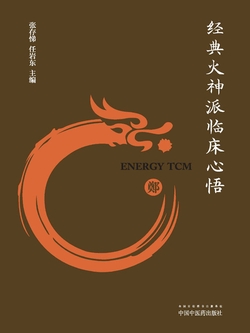
Taken from ‘Classical Clinical Insights from the Fire Spirit Current’ by Zhang Cun’ti [张存悌, 经典火神派临床心悟]
Yang qi is divided into upper, middle, and lower parts. The upper burner contains the Yang of the heart and lungs, the middle burner contains the Yang of the spleen and stomach, and the lower burner contains the Yang of the liver and kidneys. “The lower Yang is the root of the Yang of the upper and middle burners,” signifies that the Kidney Yang in the lower burner is the root of Yang qi in the upper and middle burners. In other words, among all types of Yang qi, Zheng Qin’an particularly emphasized the role of Kidney Yang. “A person’s life and destiny rely entirely on the single Yang [line] in the Kan hexagram,” indicating that Kidney Yang is the fundamental source of Yang qi in the human body and the root of life and destiny. This also forms the theoretical basis for his advocacy of using Fuzi and Sini-type prescriptions to warm and support Kidney Yang.
A friend named Mr. Huang suffered from abdominal pain in the ninth month of the Yiyou year. The pain lessened whenever he ate sweet foods. Doctors believed it to be dryness and used sweet and moistening medicines to no avail. Subsequently, they used purgative medicines, which worsened the pain. Upon examination, all six of his pulses were thin and small, he liked pressure on the abdomen, had a bland taste in his mouth, and felt fatigued. I diagnosed it as a cold condition. I prescribed Lizhong Tang with added Mu Xiang, which provided temporary relief but the pain recurred, especially at night. I said, “Night is Yin time, and Yin cold is prevalent, hence the pain worsens at night.” I then used Tongmai Sini Tang with added Baishao, and after more than ten doses, he fully recovered. (Case of Yi Jusun)
In this case of abdominal pain, the initial treatment focused on the Yang of the middle burner with “Lizhong Tang plus Mu Xiang,” which provided temporary relief. The key to the differentiating [factor of the] pattern was that “night is Yin, and Yin cold is prevalent at night, hence the pain worsens at night,” leading to the decision to specifically support Kidney Yang using Tongmai Sini Tang with added Baishao, resulting in the resolution [of the condition]. This approach is worth pondering.
From ‘The Complete Interpretation of Case Studies from Chinese Medicines’ Fire Spirit School’
中医火神派医案全解
Case: Eto, 58 years old, Japanese patient, presented with prostatic hyperplasia, which manifested with frequent, urgent and difficult urination for six years. Symptoms had been increasing over the last two to three years. Symptoms were worse in the afternoon with an inability to hold his urine in and frequent urination. In addition, he suffered from nocturia up to fifteen-sixteen times a night, scanty urine and and a weak flow. Every time he would urinate, he would have to wait three to five minutes and this was accompanied by lower abdominal swelling and distention.
Doctor Lu always treats based on the tongue, coating and pulse. [This patients] tongue body was pale and swollen with teeth marks along the edges, tongue coating was white, slippery and slimy, and pulse was deep and moderate with a lack of strength on deeper palpation. Doctor Lu felt that this was due to kidney yang weakness and debilitation as well as the settling and obstruction of water-dampness. Treatment method involved warming yang and disinhibiting water with Zhen Wu Tang [真武汤].
Zhi Fu Pian 75g (pre-cooked for two hours)
Sheng Bai Zhu 15g
Fu Ling 25g
Yin Yang Huo 20g
Sheng Jiang 60g
After one package, his urine volume increased, frequency decreased, and flow was smooth. After three packages, his urination was very smooth, nocturia reduced to two times, but he still felt that the strength of his urination was not good.
At the second consult, 25g of Gui Zhi was added, which had increased the strength of urinary flow.
At the third consult, 15g of Sha Ren was added in order to absorb the qi of the five viscera into the kidneys. All together thirty packages were taken, at which point the condition had completely improved, urination was normal, nocturia occurred once a night, and urination felt more vigorous.
Lu Chonghan believes that prostatic hyperplasia, occurs in middle aged and elderly patients, because middle aged and elderly patients’ yang qi has declined and qi transformation is deficient. Because qi transformation is deficient, this results in stoppage and obstruction of water-damp, which follows the Shaoyang triple warmer, descends, and settles in the anterior yin, eventually resulting in prostatic hyperplasia and swelling, leading to difficult urination. When serious this can cause blockage and stoppage which can result in dribbling urinary block. From the perspective of the root and branch, kidney yang vacuity and debilitation and deficient qi transformation are the root, while the pressure in the urinary tract, obstruction and lack of flow are the branch. Therefore, by grasping the root, we must warm yang, transform qi, disinhibit water and drain turbidity. Zhen Wu Tang is Zhongjing’s formula for Shaoyin yang vacuity, with water-damp collecting internally. When used for middle-aged and elderly patients with prostatic hyperplasia, the results are typically quite ideal.
In clinical practice, Zhen Wu Tang is commonly used with variations, here using Yin Yang Huo as a substitute for Bai Shao. Acrid and majorly hot Fuzi is used to strengthen kidney yang, and is able to support and overcome kidney water, which causes the exuberance of the qi of true yang, so that qi transformation moves and turbid yin can be dispelled. Shengjiang can warm the stomach and dissipate water, as well as open and diffuse lung qi, which opens the upper water-gate, achieving the objective of opening the source of water (the lungs are the upper source of water). Baizhu can move the spleen and eliminate dampness. When the spleens’ function of moving dampness is improved, water can be properly controlled. Fuling is used to blandly percolate and disinhibit water, which regulates the middle burner. This leads to the outward expelling of turbid dampness. Yin Yang Huo guides yang into yin, frees and disinhibits the blood vessels and resolves hypertonicity in the sinews, thereby achieving the objective of freeing the waterways. When these medicinals are combined, the functions of the five viscera are all regulated and rectified, the yang of qi transformation is strengthened, and the qi transformation mechanism is initiated.
How do we determine if the disease is caused by a yang vacuity? We can [diagnose it] based on the tongue, [tongue] coating, and pulse. If the tongue body is swollen and pale, with teeth marks, and the coating slippery, slimy, and white, or if the coating is white underneath and dry and yellow at the surface. From the perspective of the pulse, when the pulse is deep-slow, deep-moderate, or deep-weak, these all belong to Shaoyin yang vacuity and it can be determined that there is water-damp obstruction, which is yin cold obstruction. This is an extremely reliable pattern indicator. If turbid yin is not transformed and resolved, this easily causes settling and obstruction, which can manifest in the tongue. As a result, the tongue will commonly have teeth marks. If the tongue coating is white and slippery, this is a manifestation of a yang vacuity and loss of the warming and transformation function of true yang. When the tongue coating is white and slimy, this is a manifestation of yang vacuity cold damp obstruction in the lower burner. When the coating is white underneath and dry and yellow at the surface, this indicates that enduring damp depression is beginning to transform into heat. Although there is transformation into heat, the patient’s root pattern is still one of yang vacuity insufficiency, and in clinical practice, one must be aware of this. A deep pulse is due to yang vacuity. If all these tongue, [tongue] coating, and pulse signs exist, we can determine that the underlying patho-mechanism is one of yang vacuity damp obstruction.
The following is a case study by the late Wu Pei Heng (吴佩衡) (1886-1971) from Si Chuan province who was extremely proficient in using classical formulas and practiced in the style of the fire god school (火神派). My initial fascination with Dr Wu’s cases are his use of extremely large doses of Fu Zi. There are a number of cases in his book where he uses up to 300g a day, even with a few of his younger patients. Due to Dr. Wu’s prolific use of Fu Zi he attained the nickname ‘Wu Fu Zi’ (吴附子).
Late miscarriage blood loss
Mrs Fang, 35 years old, originally from Luo Ping county currently living in the city of Kun Ming in Yunnan province.
On May 12, 1923 she presented at the clinic after suffering a miscarriage in her fifth month of pregnancy. Initially she felt painful sagging in her abdomen and low back which continued until she miscarried. She had excessive menstrual bleeding (flooding) with clots, twisting abdominal pain, flusteredness, dizziness and shortness of breath. Her pulse was scallion like, vacuous, weak and both inch positions were short. Her lips were pale red, tongue coating was slippery white and the tongue body was bluish and dark. According to her husband on that particular evening she had fainted twice. Late miscarriages are usually due to major vacuity of kidney qi, qi vacuity sinking and unable to absorb blood, and yang qi descending with blood and escaping. The qi is born within the kidneys and gathers in the lungs and here we have a lack of merger between the kidneys and lungs, therefore there is shortness of breath with desertion. The plan is to administer Si Ni Dang Gui Bu Xue Tang with (Da) Zao and Ai (Ye). Within the formula, Si Ni Tang supports Yang allowing it to rise. The assistants (Huang) Qi and Dang Gui supplement the centre, boost qi and re-generate the excessively damaged blood. Gan Jiang, Ai (Ye) and (Da) Zao blackened, can warm the blood, separate the cold and return blood back to the channels.
Formula:
Hei Fu Pian 160g
Pao Hei Jiang 50g
Zhi Gan Cao 24g
Bei Kou Qi 60g
Dang Gui 26g
Qi Ai 6g (fried until blackened)
Da Zao 5 pieces (roasted until blackened)
After taking 13 days worth of formula, her menstrual flooding stopped, the shortness of breath was calmed and most of her symptoms were alleviated by days 6 or 7 and even her spirit was slightly improved. In keeping with the original formula, another 14 days were given to complete the course, after which she successfully recovered.
 Eran Even, Ph.D., Dr. TCM.