1. What is Treatment Based on Pattern Identification
 Pattern identification is a method in which (one) gathers disease responses and symptoms through the four diagnostic methods, and also uses Chinese medical theory to summarize and analyze (these responses) in order to distinguish the disease nature and location (and to have) a clear understanding of the disease signs. This is another step in elucidating the pattern involved, and this process is referred to as pattern identification. Determining treatment is essentially the use of medicinals in accordance with the pattern. The characteristic (of this process) is that both the patient and the doctor work together in gathering the symptoms (to obtain information), and the doctor, in accordance with Chinese medical theory, will summarize and analyze (these) to have a clear understanding of where these signs belong (information classification), in order to clearly define the pattern (treating the specific information), and use medicinals according to the pattern (information processing). This is the entire process involved in treating disease.
The pattern identification methods commonly used in Chinese medicine are: eight principles pattern identification, bowel and viscera pattern identification, qì, blood, liquids, and humors pattern identification, defensive qì and nutritive blood pattern identification, triple warmer pattern identification, channels and collaterals pattern identification, six conformation pattern identification, and so on. The Shāng hán lùn (傷寒論 Discussion of Cold Damage) specifically uses the six conformations pattern identification method.
2. The Evolution of the Shāng hán lùn’s Treatment Based on Pattern Identification
Treatment based on pattern identification is also referred to as treatment based on pattern differentiation. The Chinese medicine use of formulas and medicinals to treat disease is a particularly traditional method, which has been put into practice for extensive periods of time by our ancestors through the ages to combat disease, and is summed up as a major extraordinary accomplishment. The earliest recording, which established and summarized these methods is found in the Decoction classic (汤液经法).
3. Discussion on the Six Conformations and Eight Principles
The Shāng hán lùn (傷寒論 Discussion of Cold Damage) used the six conformations as a method of division. Later commentators have stated that with the six conformations, one would only be confined to cold damage methods. In fact, the six conformations come from the eight principles (and are the) general principles behind (the treatment) of numerous diseases. In order to explain further, the following discussion will begin from the eight principles.
(1) Eight Principles [八钢 ]
The eight principles refer to the exterior, interior, yīn, yáng, cold, heat, vacuity, and repletion. In actual fact, within the exterior and interior, there is also the half-exterior and half-interior, so really, they should be called the nine principles. However, the half-exterior, half-interior portion is usually discussed with the interior, so it is customary to simply refer to them as the eight principles. I will now explain them in order.
The Exterior, Interior, and Half-Exterior Half-Interior:
The exterior, interior, and half-exterior half-interior are essentially the location of a disease response. The exterior refers to the exterior of the body, namely the skin, muscles, flesh, tendons, and bones, and anything, which constitutes the outer part of the body can be called the exterior. If pathogenic factors accumulate and cause a reaction in this part of the body, we can call this an exterior pattern. The interior refers to the inner aspect of the body, namely the esophagus, stomach, large intestine, and small intestine, and anything, which constitutes the digestive tract, is referred to as the interior. If pathogenic factors accumulate and elicit a response in this part of the body, this can be called an interior pattern. The half-exterior half-interior portion refers to the exterior of the interior, and the interior of the exterior, which is namely the large space between the chest and abdomen. This is the location of all the organs and bowels, and is considered to be the half-exterior half-interior portion of the body. If pathogenic factors accumulate here and cause a reaction, this is called a half-exterior half-interior pattern. It needs to be explained here that the exterior, interior, and half-exterior half-interior disease location responses are fixed, and regardless of what the disease is, (one needs to look at) the location of the disease response, whether it be in the exterior, interior, or half-exterior half-interior. In addition, two or even all three of these may sometimes appear simultaneously. It must also be emphasized that here when discussing disease location, it refers to the location of the response to the disease pathogens, and not to be mistakenly believed to be the location of the disease changes. That is to say, if there are pathological changes in the interior, but pathogenic factors have accumulated and caused a response in the exterior, this is referred to as an exterior pattern, and is also referred to as pathogens in the exterior or an exterior disease. For the same reason, even if a condition manifests with exterior symptoms, yet there is an accumulation of pathogenic factors with a response in the interior of the body, this is referred to as an interior pattern, for which it can also be said that pathogens are in the interior, or simply called an interior disease.
Yīn and Yáng: Yīn and Yáng refer to the nature of the pathological changes. Yīn has namely a yīn nature, and yáng a yáng nature. When a person contracts a disease, there will be a struggle between right (qì) and the pathogen. This will have not yet influenced any changes of bodily functions, and will particularly first make changes to metabolic functions. If this change is relatively abnormal, than it is called excessive, and if relatively normal, it is considered deficient. With excess, the body will correspond with and reflect hyperactivity, rising, and excited types of disease characteristics, which are referred to as a yáng pattern. With deficiency, the body will reflect decline, hypo-function, and inhibition types of deficient disease characteristics, which are referred to as a yīn pattern.
Cold and Heat:
Cold refers to a cold type of pattern, while heat refers to a hot type of pattern. If a patient reflects cold natured symptoms, then this is ultimately considered a cold pattern; if a patient reflects heat type symptoms, then this is referred to as a heat pattern. As was mentioned above in the explanation of yīn and yáng, cold is a reflection of deficiency, which belongs to yīn, therefore cold is also yīn, and heat is a reflection of excess, which belongs to yáng, so therefore heat must also be yáng. However, cold and heat have characteristics of yīn and yáng, and if we generally say yīn, then indefinitely there must be cold, and if we say yáng, then there will indefinitely be heat. In instances of an absence of cold or heat in disease, this by no means indicates an absence of yīn or yáng.)
Vacuity and Repletion:
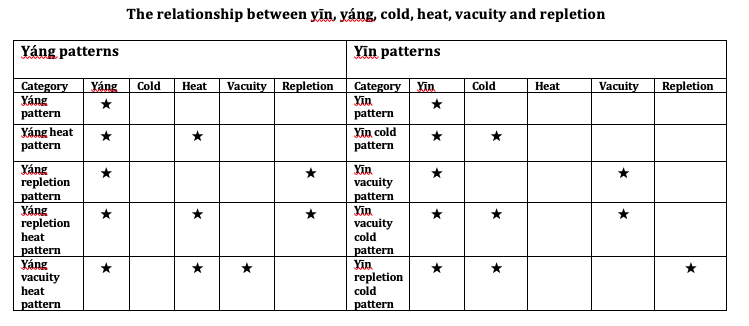
Vacuity refers to a vacuous patient, while repletion refers to repletion of disease (factors). If a disease has not yet been resolved, and a patients’ energy is failing to sustain to some extent, the reflection of the body manifests a type of vacuous, debilitated state, which is typically referred to as a vacuity pattern. If the dynamics of the disease are advanced, and the patients’ energy is not vacuous, the body will manifest with disease characteristics of fullness and repletion, which would be referred to as a repletion pattern. From the aforementioned explanation, we are able to see that vacuity, repletion, cold and heat are similar, containing both yīn and yáng characteristics within them. When vacuity, repletion and cold intertwine with one another, there is still (either) yīn or yáng. For example, vacuity and cold are definitely yīn, but vacuity and heat is on the contrary yáng. Repletion and heat are most certainly yáng, however, repletion and cold would be considered yīn. In a yáng pattern it is possible to have heat, or repletion, or heat with repletion, no heat or no repletion, or even heat and vacuity. In a yīn pattern, we can have either cold, or vacuity, or vacuity with cold, no cold or no vacuity, or cold with repletion. This can be seen in the following chart.
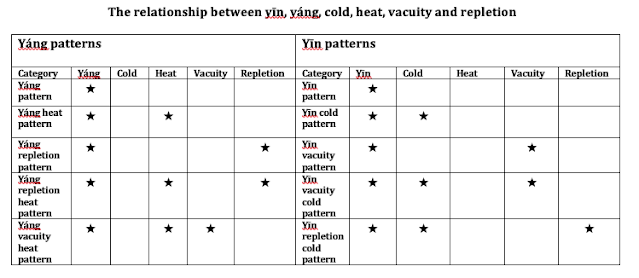
(1) Six Conformations (六经)
The six conformations refers to the three yáng conformations of Tài Yáng, Yáng Míng, and Shào Yáng, and the three yīn conformations of Tài Yīn, Shào Yīn, and Jué Yīn. Although the Shāng hán lùn (傷寒論 Discussion of Cold Damage) refers to these as diseases, they are actually patterns, which come from the eight principles. I will now explain the relationships between them.
The so-called exterior, interior, and half exterior half interior, all reflect disease location, while yīn, yáng, cold, heat, vacuity, and repletion reflect the nature of the disease. However, the manifestation of the disease nature must reflect the disease location, and the location of the disease will inevitably reflect the nature of the disease, therefore, without the nature of the disease, there is no location, and vice versa. Exterior, interior, or half exterior half interior patterns will always be accompanied by signs of either yīn, yáng, cold, heat, vacuity or repletion. At the same time, yīn, yáng, cold, heat, vacuity, and repletion patterns will be accompanied by exterior, interior, or half exterior half interior signs. Therefore, regardless of whether it’s an exterior, interior, or a half exterior half interior pattern they will all be accompanied by various yīn and yáng signs and responses.
Disease location and nature of the six conformations
|
Eight Principles
|
Disease nature
|
|
Six conformations
|
Disease location
|
|
Exterior
|
Yáng
|
Tài Yáng disease
|
|
Interior
|
Yáng
|
Yáng Míng disease
|
|
Half exterior half interior
|
Yáng
|
Shào Yáng disease
|
|
Interior
|
Yīn
|
Tài Yīn disease
|
|
Exterior
|
Yīn
|
Shào Yīn disease
|
|
Half exterior half interior
|
Yīn
|
Jué Yīn disease
|
The following are the representative lines from the Shāng hán lùn (傷寒論 Discussion of Cold Damage) for each of the six conformations with a small commentary.
“In Tài Yáng disease, the pulse is floating, the head and nape are stiff and painful, and there is aversion to cold” [line 1]
Commentary: Tài Yáng disease is an exterior yáng pattern. The characteristics signs of a Tài Yáng disease are a floating pulse, stiff and painful head and nape, and aversion to cold. With that being said, in any disease, whenever a floating pulse, a stiff and painful head and nape, and aversion to cold are seen, one can most certainly diagnose it as a Tài Yáng disease, thereby avoiding any errors.
“In Yáng Míng disease, the stomach domain is replete” [line 180]
Commentary: Yáng Míng disease is an interior yáng pattern. The term ‘stomach domain is replete’ means that pathogens are full and replete in the stomach and intestines, and with palpation is hard with resistance and possibly painful on pressure. The general idea here is that any disease with a replete stomach domain, can definitely be considered a Yáng Míng disease.
“What are the external signs of Yáng Míng disease? Answer: generalized heat effusion, spontaneous sweating, and no aversion to cold, but aversion to heat” [line 182]
Commentary: The stomach domain being replete, is a Yáng Míng disease abdominal finding, and in addition there is also a Yáng Míng disease exterior pattern. Symptoms of generalized heat effusion, spontaneous sweating, and no aversion to cold, but aversion to heat exemplify the exterior pattern. Any disease with these external signs can be diagnosed as a Yáng Míng disease.
“In Shào Yáng disease, there is a bitter taste in the mouth, dry throat, and dizzy vision” [line 263]
Commentary: Shào Yáng disease is a half exterior half interior yáng pattern. The characteristic symptoms for a Shào Yáng pattern are a bitter taste in the mouth, dry throat, and dizzy vision. Any disease with these characteristic signs could be diagnosed as a Shào Yáng disease.
Commentary: Tài Yīn disease is an interior yīn disease. The characteristic symptoms of a Tài Yīn disease are abdominal fullness and vomiting, inability to get food down, severe spontaneous diarrhea, and periodic spontaneous abdominal pain. Any disease manifesting these characteristics can be diagnosed as a Tài Yīn disease. The abdominal fullness in a Tài Yīn disease is a vacuity type of fullness, which is quite different than the repletion fullness seen in a Yáng Míng repletion of the stomach domain disease. If one erroneously mistakes this for a repletion type of fullness and purges it, this will further increase the vacuity and cause a hard bind below the chest.
“In Shào Yīn disease, the pulse is faint and fine, and there is a desire only to sleep” [line 281]
Commentary: Shào Yīn disease is an exterior yīn pattern, which needs to be compared to a Tài Yáng pattern. Basically, if there is a Tài Yáng pattern with a faint and fine pulse, accompanied by a desire only to sleep, this can be diagnosed as a Shào Yīn disease.
Commentary: Jué Yīn disease is a half exterior half interior yīn disease. The symptoms which typically reflect a Jué Yīn disease are wasting thirst, qi surging upward to the heart, pain and heat in the heart, hunger with no desire to eat, and vomiting of roundworms after eating. Any disease seen with these symptoms can be considered a Jué Yīn disease. Half exterior half interior pattern cannot be purged, and it is especially strictly prohibited when they are yīn patterns. If one is not careful and erroneously uses purgation, then this will cause a calamity of incessant diarrhea.
1. Summary of Treatment Principles
The so-called treatment principles are essentially the principle of determination of treatment based on six conformation and eight principles pattern identification. I will now differentiate and give an account of these principles.
Tài Yáng disease: Because this is an exterior pattern, it is appropriate to effuse sweat, and not to purge nor cause vomiting. Formulas such as guì zhī tāng (Cinnamon Twig Decoction), má huáng tāng (Ephedra Decoction), and gé gēn tāng (Kudzu Decoction) are specific sweat effusing Tài Yáng disease formulas.
Shào Yīn disease: This is a type of Tài Yáng disease, and although they both belong to the exterior, for which sweating should resolve it, here sweat effusion must be combined with warm natured, stimulating medicinals such as fù zǐ (Aconiti Radix lateralis preparata), and xì xǐn (Asari Herba) in formulas such as guì zhī jiā fù zî tāng (Cinnamon Twig Decoction plus Aconite), má huáng fù zǐ gān cǎo tāng (Ephedra, Aconite Accessory Root Tuber and Licorice Decoction), and má huáng fù zǐ xì xīn tāng (Ephedra, Aconite Accessory Root Tuber and Asarum Decoction). These are specific Shào Yīn sweat effusing formulas.
Yáng Míng disease: When heat has bound in the interior and the stomach domain is replete, it is appropriate to purge it. However, when there is (simply) heat and no repletion (in the stomach domain), it is appropriate to simply clear heat. A typical purging formula would be one of the chéng qì tāng (Order the Qi Decoction) formulas, and bái hǔ tāng (White Tiger Decoction) to clear heat. If there is repletion in the chest, it is appropriate here to cause vomiting and not to purge using a formula such as guā dì sǎn (Melon Stalk Powder).
Tài Yīn disease: With interior vacuity and cold obstruction, only warming and supplementation is warranted. The promotion of sweat, vomiting and purgation are all contraindicated. Formulas such as lǐ zhōng tāng (Regulate the Middle Decoction), and sì nì tāng (Frigid Extremities Decoction) are typical Tài Yīn warming and supplementing formulas.
Shào Yáng disease: In half exterior half interior patterns, the appropriate method of treatment is to harmonize and resolve. Promoting sweating, vomiting and purgation are all unnecessary. xiǎo chái hú tāng (Minor Bupleurum Decoction) and huáng qín tāng (Scutellariae Decoction) are prototypical Shào Yáng harmonizing and heat resolving formulas.
Jué Yīn disease: Although this is also a half exterior half interior pattern, for which harmonizing and resolving are appropriate, this must be combined with warm, strengthening medicinals. Chái hú guì zhī gān jiāng tāng (Bupleurum, Cinnamon Twig, and Ginger Decoction) and wū méi wán (Mume Pill) are typical formulas for this pattern.
Cold and Heat: In cold patterns, warming medicinals should be used to expel cold such as gān jiāng (Zingiberis Rhizoma), fù zǐ (Aconiti Radix lateralis preparata), and wū tóu (Aconiti Kusnezoffi Radix) in combination with specific formulas. In heat patterns, cool and cold medicinals are used in order to eliminate heat such as huáng qín (Scutellariae Radix), zhī zǐ (Gardeniae Fructus), huáng lián (Coptidis Rhizoma), and shí gāo (Gypsum fibrosum) in combination with specific formulas.
Vacuity and Repletion: In vacuity patterns it is appropriate to use strengthening medicinals in order to supplement insufficiency. Sweat promoting, vomiting, and purgative medicinals are all contraindicated. Formulas such as zhì gān cǎo tāng (Honey-Fried Licorice Decoction), lǐ zhōng tāng (Regulate the Middle Decoction), and shèn qì wán (Kidney Qì Pill) are all used to supplement vacuity. In repletion patterns, sweat promoting, vomiting inducing, and purgation are all methods, which are utilized to thoroughly attack and eliminate pathogenic factors. Examples of attacking repletion formulas would be má huáng tāng (Ephedra Decoction) and dà chéng qì tāng (Major Order the Qi Decoction).
Case Example:
Guì Zhī Jiā Gé Gēn Tāng (Cinnamon Twig Decoction plus Kudzu)
On December 10, 1965 a twenty one-year-old female presented at the clinic. Yesterday she had contracted a common cold manifesting with symptoms of headache, dizziness, sweating, aversion to cold, weak pain in her shoulders and back, and a tight obstructive pain in the left side of her neck on rotation towards the left. She had a thin white tongue coating, and her pulse was floating and slightly rapid.
A floating, slightly rapid pulse, thin-white tongue coat, aversion to cold, sweating, and headaches signify a Tài Yáng wind strike pattern. Shoulder and back pain, and neck pain on left rotation of the head signify a gé gēn tāng (Kudzu Decoction) pattern. The dizziness indicates that the exterior has not yet been resolved, with upward surging of qì.
Comprehensive analysis: This is a Tài Yáng wind strike pattern with simultaneous stretched stiff nape and back, seen in a guì zhī jiā gé gēn tāng (Cinnamon Twig Decoction plus Kudzu) formula presentation.
Formula:
guì zhī (Cinnamomi Ramulus) 10g
bái sháo (Paeoniae Radix alba) 10g
shēng jiāng (Zingiberis Rhizoma recens) 10g
dà zǎo (Jujubae Fructus) 4 pieces
zhì gān cǎo (Glycyrrhizae Radix preparata) 6g
gé gēn (Kudzu Radix) 12g
Results: After taking 1 package of the formula, her symptoms decreased, and after 2 more, her symptoms had completely resolved.



 Bái Zhú from Zhāng Zhì-Cōng’s Běn Cǎo Chóng Yuán (
 Eran Even, Ph.D., Dr. TCM.