Huáng Qín Tāng [Line 172]

Chéng Wú-Jǐ 成无己

From ‘A commentary on the Annotated Shāng Hán Lùn’ (注解伤寒伦) by Chéng Wú-Jǐ

Line 172 

In a Tài Yáng and Shào Yáng combination disease with spontaneous diarrhea, give huáng qín tāng (Scutellaria Decoction); if there is retching, huáng qín jiā bàn xià shēng jiāng tāng (Scutellaria Decoction plus Pinellia and Fresh Ginger) rules it. 

Commentary: In a Tài Yáng and Yáng Míng combination disease, spontaneous diarrhea is coming from the exterior, and gé gēn tāng (Kudzu Decoction) is given to effuse sweat. In a Yáng Míng and Shào Yáng combination disease, spontaneous diarrhea is coming from the interior, and a chéng qì tāng (Order the Qi Decoction) formula is used to precipitate it. This is a Tài Yáng and Shào Yáng combination disease, and the spontaneous diarrhea is a result of the condition being half in the exterior and half in the interior. Here it would be inappropriate to promote sweat or precipitate, so huáng qín tāng (Scutellariae Decoction) is given to harmonize and resolve the pathogens laying half in the exterior and half in the interior. Retching indicates counterflow of stomach qì so bàn xià (Pinelliae Rhizoma preparatum) and shēng jiāng (Zingiberis Rhizoma recens) are added to dissipate counterflow qì.

Huáng Qín Tāng (Scutellariae Decoction)

huáng qín (Scutellariae Radix) 3 liǎng (9g) [acrid-cold]
zhì gān cǎo (Glycyrrhizae Radix preparata) 2 liǎng (6g) [sweet-neutral]
sháo yào (Paeoniae Radix) 2 liǎng (6g) [sour-neutral]*
dà zǎo (Jujubae Fructus) 12 pieces, broken [sweet-warm]

*In the Běn Cǎo Jīng, sháo yào (Paeoniae Radix) is classified as bitter, and is considered to be mildly cold in the Míng Yī Bié Lù.

Commentary: In vacuity and non-repletion, (the) bitter (flavor) is used to harden, and sour is used to contract. huáng qín (Scutellariae Radix) and sháo yào (Paeoniae Radix) are bitter and sour, and are used to harden and constrain the qì of the stomach and intestines. In weakness and insufficiency, (the) sweet (flavor) is used to supplement. gān cǎo (Glycyrrhizae Radix) and dà zǎo (Jujubae Fructus) are both sweet and can supplement and secure stomach and intestinal weakness.

Simmer the four ingredients above in 1 dǒu of water (2,000ml) until reduced to 3 shēng (600ml). Remove the dregs and take 1 shēng (200ml) heated, twice during the day and one at night. If there is retching, add ½ shēng (100ml) of bàn xià (Pinelliae Rhizoma preparatum) and 3 liǎng (9g) of shēng jiāng (Zingiberis Rhizoma recens)*.

*The Sòng dynasty version does not include this modification but has a separate line for huáng qín jiā bàn xià shēng jiāng tāng (Scutellaria Decoction plus Pinellia and Fresh Ginger).

Tài Yáng flow charts

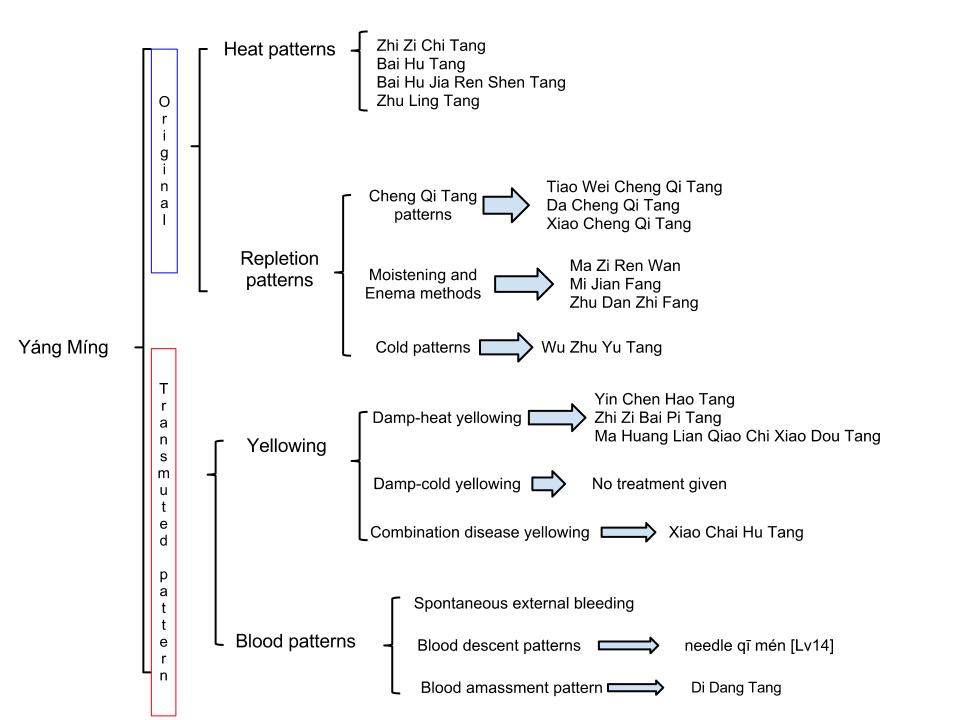
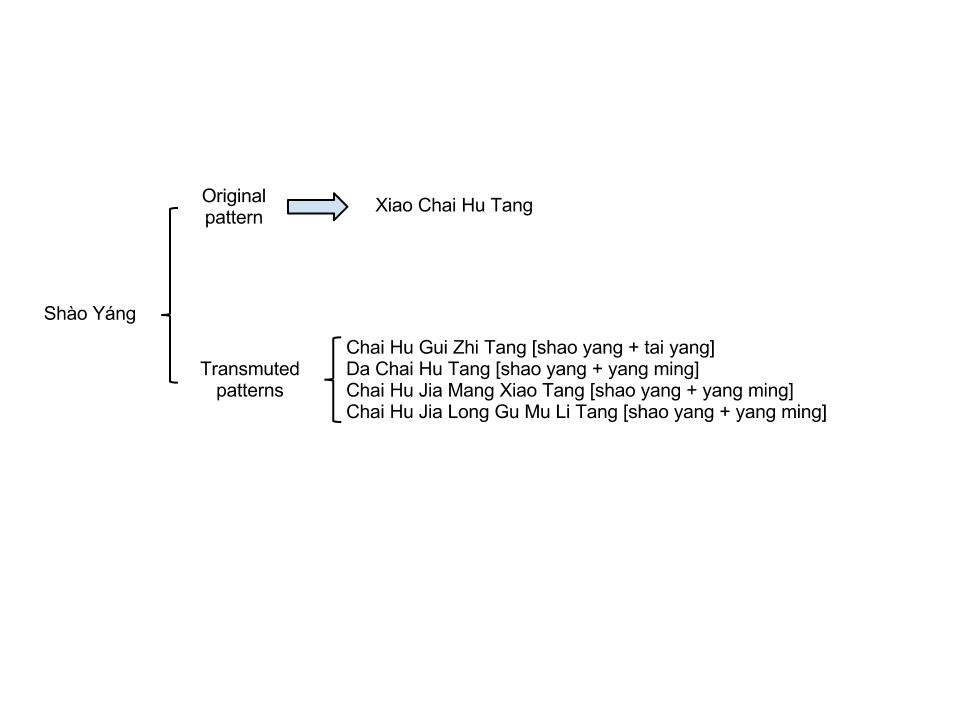
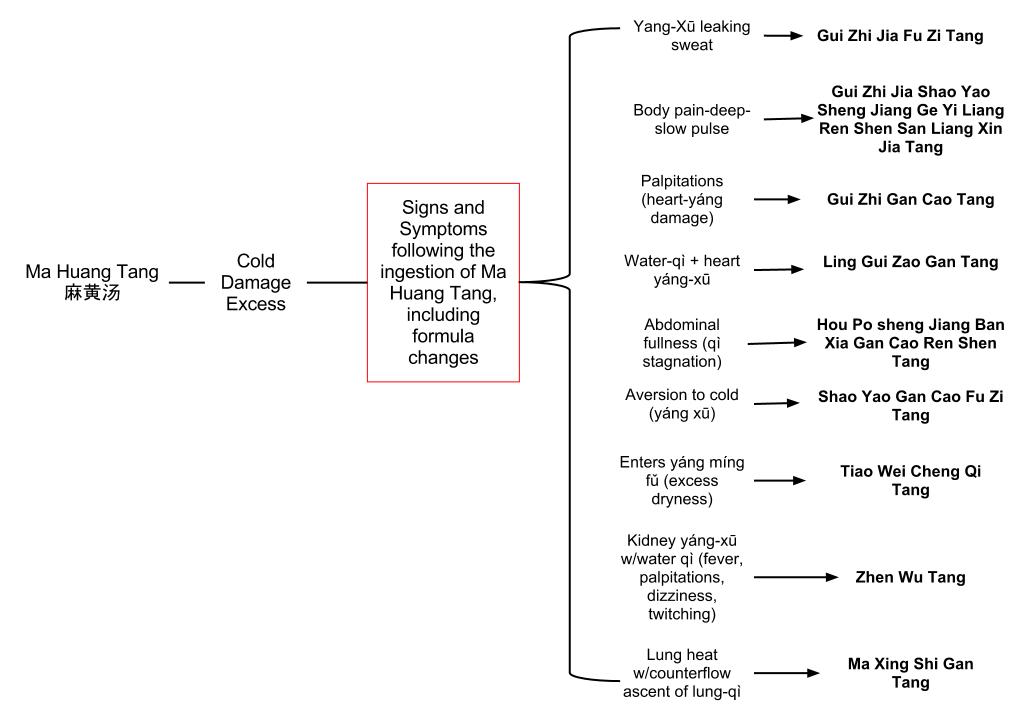
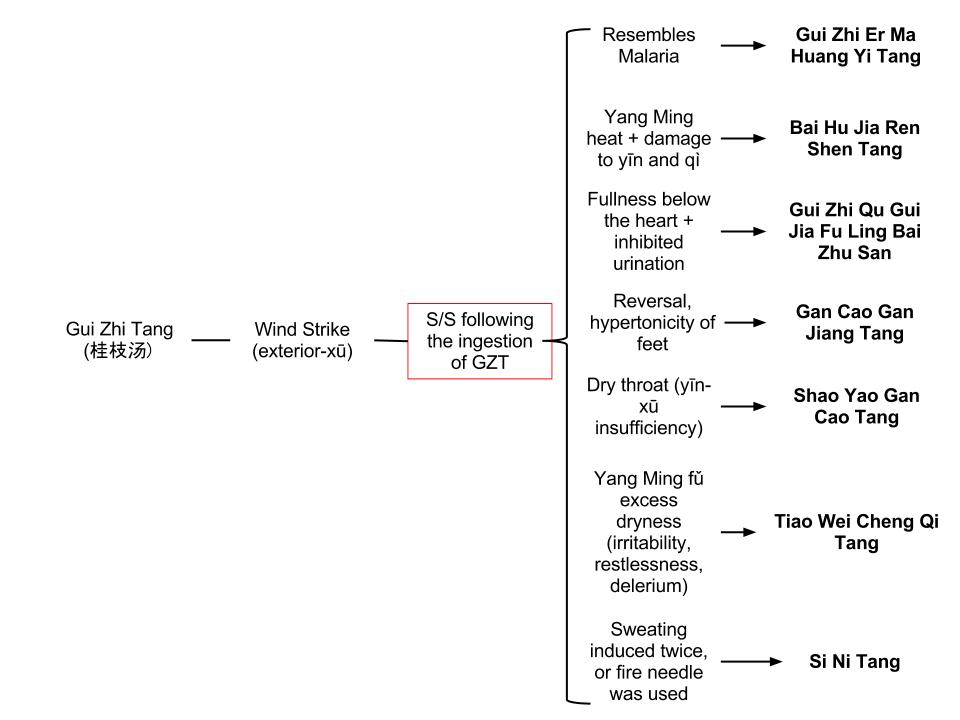
Digging through some of my papers over the weekend, I found an old chart I have, which gives a breakdown of the patterns found in the Shāng Hán Lún (伤寒论), with corresponding formulas, in a neat little flow chart format.  I decided to translate it this morning as I think it\’s pretty cool.  I\’ve started with the Tài Yáng section, and will finish up the rest in the next few days.  Enjoy!

Shāng Hán Lùn Formula Charts

A few years ago I bought a little book on the Shāng hán lùn (傷寒論 Discussion of Cold Damage) which has some pretty cool summary charts at the end of each chapter.  The name is escaping me now, and since most of my books are currently in boxes, I’ll have to re-post it at a later date.
I’ve always found charts to be helpful in my learning process, so I thought I’d post a couple of them here.  So far I’ve only done a couple, so as time goes by (and permits), I’ll post more.  


Bái Tóng Tāng (Scallion [Yáng] Freeing Decoction)

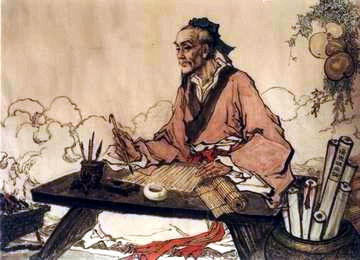
[Formula Composition] zhangzhongjing.jpg
cōng bái (Allii fistulosi Bulbus) 4 stems
gān jiāng (Zingiberis Rhizoma) 1 liǎng
fù zǐ (Aconiti Radix lateralis preparata) 1 piece (raw, skin removed, break into 8 pieces) 

[Usage] For the three ingredients above, use three shēng of water, and boil until one shēng remains. Remove the dregs, divide into two doses, and take warm twice daily. 

[Interpretation of Formula Presentation] This formula’s function is to break yīn, return yáng, and diffuse and free the upper and lower burners. It is essentially sì nì tāng (Frigid Extremities Decoction) with the moderating gān cǎo (Glycyrrhizae Radix) removed, and the yīn breaking, yáng freeing cōng bái (Allii fistulosi Bulbus) added. This formulas presentation is one of yīn exuberance and yáng deficiency. The repelling of yáng is the main pathomechanism involved in this presentation. It is quite easy to recount the usage of this formula from the Shāng hán lùn (傷寒論 Discussion of Cold Damage), as it is simply a Shào Yīn pattern with diarrhea, and a faint pulse. In addition to these signs, in clinical practice we may also see; reversal-flow in the extremities, fear of cold, a cold back, throat pain, a pale throat, diarrhea with undigested food particles, a slippery-white tongue coating, and a faint, deep, and hidden pulse. 

If yáng repels upwards, we may see a reddish facial complexion as if makeup were applied, which is why this presentation is sometimes called ‘upcast yang pattern’. Both bái tóng tāng (Scallion [Yáng] Freeing Decoction), and tōng mài sì nì tāng (Vessel Freeing Frigid Extremities Decoction) are used in patterns of yáng deficiency and weakness, yīn exuberance, and repelling yáng. The Bái Tóng Tāng (Scallion [Yáng] Freeing Decoction) presentation is characterized by exuberant interior yīn cold, with repelling of yáng into the upper burner, and can therefore be referred to as a ‘yīn exuberant, upcast yáng pattern’. tōng mài sì nì tāng (Vessel Freeing Frigid Extremities Decoction) on the other hand is characterized by exuberant interior cold, and repelling of yáng into the exterior, and can therefore be referred to as a ‘yīn exuberant, yáng repelling pattern’. Essentially, both these formulas are quite different, and must be differentiated. 

[Primary Patterns]
 “In Shào Yīn disease with diarrhea, Bái Tóng Tāng (Scallion [Yáng] Freeing Decoction) masters it”(Shāng hán lùn (傷寒論 Discussion of Cold Damage) line 314) 

“In Shào Yīn disease, with diarrhea and a faint pulse, give Bái Tóng Tāng (Scallion [Yáng] Freeing Decoction)………..” (Shāng hán lùn (傷寒論 Discussion of Cold Damage) line 315) 

Two Cases using Bái Tóng Tāng (Scallion [Yáng] Freeing Decoction) 

(1) A Pattern of Reverse-Flow Upcast Yáng in Pregnancy 

Lǐ Xiǎo-Pǔ
Journal of the Yúnnán College of Traditional Chinese Medicine, (1979; 2: 40) 

The following is a case of a thirty-six year old female patient treated in hospital after losing consciousness. After getting out of bed that morning, she had felt completely normal, but had suddenly experienced dizziness and flowery vision. After falling over in her kitchen, she went to bed to quietly lie down, and it was at this point that she had lost consciousness. 

Consultation: The following signs and symptoms were noted; a hidden, imperceptible pulse, reversal cold in the extremities, white facial complexion, with slightly red cheekbones, and occasional nausea with a desire to vomit. 

The dizziness and reversal were due to the dual deficiency of liver and kidney yáng. The exuberance of yīn qì in the lower burner caused deficient yáng to float upwards, bringing forth the signs of upcast yáng. At this point she had just entered her ninth month of pregnancy. In this particular case, a modified version of Bái Tóng Tāng (Scallion [Yáng] Freeing Decoction) was indicated. 

Formula: 

fù zǐ (Aconiti Radix lateralis preparata) 15g
gān jiāng (Zingiberis Rhizoma) 9g
chǎo zhū yú (Evodiae Fructus preparata) 6g
gōng dīng xiāng (Caryophylli Flos) 2.4g
guì zhī (Cinnamomi Ramulus) 9g
cōng bái (Allii fistulosi Bulbus) 3 stems
zhì gān cǎo (Glycyrrhizae Radix preparata) 6g 

After taking the above decoction, sounds of water seeping through her chest and abdomen were noted, and afterwards copious amounts of water were discharged trough a bowel movement. When returning to visit her later in the afternoon, she was already feeling normal and had completely recovered. She was still experiencing diarrhea, so a modified version of lǐ zhōng tāng (Regulate the Middle Decoction) was administered. 

(2) Yáng deficiency headache 

Liú Yǔ
Journal of the Shāndōng University of Traditional Chinese Medicine (1977; 1: 30) 

A twelve-year old male student was brought to the clinic for a consultation. Every morning after getting up, he experienced continuous headaches, which were accompanied by spontaneous sweating, exhaustion, a fear of cold with a desire to be warm, a pale tongue body with a white coat, and a deep-thin and strengthless pulse. If no treatments were administered the headaches would usually subside by the afternoon. Previous Chinese medicine doctors treated his headaches as qì deficiency type headaches, which offered no relief, and was now seriously starting to affect his studies. 

The author treated this as yáng deficiency type headaches and used Bái Tóng Tāng (Scallion [Yáng] Freeing Decoction) with the addition of zhì gān cǎo (Glycyrrhizae Radix preparata), and after 2 packages, the headaches disappeared. 

Formula: 

shú fù zǐ (Aconiti Radix lateralis preparata) 6g
gān jiāng (Zingiberis Rhizoma) 4.5g
zhì gān cǎo (Glycyrrhizae Radix preparata) 4.5g
cōng bái (Allii fistulosi Bulbus) 2 stems 

Translated from the ‘Zhāng Zhòng-Jǐng Formula studies’ book (张仲景方剂学), compiled by Lǔ Zhì-Jié, and published by the China Medical Science Press (2005)
5 Steps to ‘Shang Han’ treatment

I am currently reading a book titled ‘5 Steps to Shang Han treatment based on Pattern Identification”. It is a fascinating look at a very systematic approach to diagnosis and treatment using the formulary of Zhang Zhong Jing. The book is essentially centred around three very famous modern physicians, Hu Xi Shu (胡希恕), Liu Du Zhou (刘渡舟) and Fan Zhong Lin(范中林). The book includes numerous case studies by each one of them detailing their step-by-step process from diagnosis to treatment. The 5 step process is as follows;

I. TCM diagnosis (signs, symptoms, origin and constitution of patient)
II. List of disease mechanisms (6 channel differentiation, differentiation of principles, zang-fu, channels, etc…)
III. Comprehensive analysis (detailing process and location of disease)
IV. Formulas according to pattern
V. Medicinals according to pattern

I would like to offer a translation of one case from the book by Fan Zhong-Lin a prominent physician in the Fire God school of thought (火神派).

Mr.Yang, a 54 year old male from Cheng Du presented at the clinic.

Step 1: Chinese medical diagnosis
October, 1960. Over the last 2 years every day after breakfast, the patient felt very warm and feverish. His body temperature was always around 38 degrees celcius. He had relatively copious sweating that would go on for about 2 hours. Once the heat would decline, the sweating would stop and he would feel an aversion to cold. His daily symptoms included; dizziness, a bitter taste in the mouth, dry throat, chest and rib-side fullness as well as vexation and agitation felt in the chest. His tongue body was red and the coating was slightly yellow and greasy. Pulse was wiry-rapid. At his previous hospital examination the cause of his fevers were unknown and the medications administered had very little effect.

Step 2: List of disease mechanisms
The wiry pulse, alternating cold and heat, bitter taste in the mouth, dry throat, dizziness, chest and rib-side fullness and heart vexation are all obvious Shao-Yang channel signs and symptoms.

Step 3: Comprehensive Analysis

This is Shao-Yang channel disease heat effusion. Treatment methods should involve harmonizing and resolving the Shao-Yang.

Step 4: Formula according to pattern
Xiao Chai Hu Tang with additions and subtractions governs.
This condition has been going on for 2 years so as the Shang Han Lun says “When Chai Hu signs still exist, administer Xiao Chai Hu Tang”

Step 5: Medicinals according to pattern

Because the signs of heat effusion, sweating, thirst and a red tongue signify depressed heat, we remove Sheng Jiang (Rhizoma Zingiberis) and Da Zao (Fructus Jujubae) , and add Zhi Mu (Rhizoma Anemarrhenae) and Shi Gao (Gypsum Fibrosum) to clear heat.
In addition, because the chest and rib-side fullness were quite severe, this can signify that the pattern is interspersed with damp evils, therefore Mu Li (Concha Ostreae), Chen Pi (Pericarpium Citri reticulatae) and Fu Ling (Poria cocus) were added to percolate dampness, transform stasis and disperse bind.

Formula:

Chai Hu 24g
Huang Qin 10g
Fa Ban Xia 15g
Sha Shen 15g
Gan Cao 10g
Zhi Mu 15g
Shi Gao 30g
Mu Li 24g
Chen Pi 9g
Fu Ling 12g

After taking one package of the above formula, the heat declined and there was a reduction in most of his symptoms. After stopping the herbs he was instructed to rest and take care of himself for several days and afterwards he would recover. After much time the patient had come to visit Dr. Fan at his home and reported the condition had not recurred.